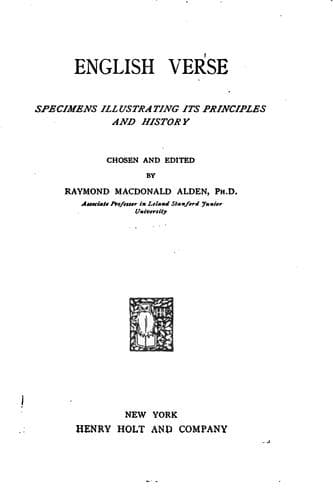
English Verse: Specimens Illustrating its Principles and HistoryAlden, Raymond MacDonald
General
English Verse: Specimens Illustrating its Principles and History
Alden, Raymond MacDonald
English language -- Versification; English poetry
Oh it is pleasant, with a heart at ease,
Just after sunset, or by moonlight skies,
To make the shifting clouds be what you please,
Or let the easily-persuaded eyes
Own each quaint likeness issuing from the mould
Of a friend's fancy; or, with head bent low
And cheek aslant, see rivers flow of gold
'Twixt crimson bank; and then, a traveler, go
From mount to mount through Cloudland, gorgeous land!
Or listening to the tide, with closed sight,
Be that blind bard who, on the Chian strand
By those deep sounds possessed with inward light,
Beheld the Iliad and the Odyssee
Rise to the swelling of the voiceful sea.
(COLERIDGE: _Fancy in Nubibus_. 1819.)
The sonnets of Coleridge, as has already been noted, were written under
the influence of those of Bowles, and are not of the Italian type. He
defined the sonnet as "a short poem in which some lonely feeling is
developed," thus emphasizing, like Wordsworth, the idea of unity rather
than of progressive structure.
Darkly, as by some gloomed mirror glassed,
Herein at times the brooding eye beholds
The great scarred visage of the pompous Past,
But oftener only the embroidered folds
And soiled regality of his rent robe,
Whose tattered skirts are ruined dynasties
And cumber with their trailing pride the globe,
And sweep the dusty ages in our eyes;
Till the world seems a world of husks and bones
Where sightless Seers and Immortals dead,
Kings that remember not their awful thrones,
Invincible armies long since vanquished,
And powerless potentates and foolish sages
Lie 'mid the crumbling of the mossy ages.
(WILLIAM WATSON: _History_.)
FOOTNOTES:
[35] It will perhaps be found of interest to reproduce the "Ten
Commandments of the Sonnet" given by Mr. Sharp in his Introduction to
_Sonnets of this Century_ (p. lxxviii):
"1. The sonnet must consist of fourteen decasyllabic lines.
"2. Its octave, or major system, whether or not this be marked by a
pause in the cadence after the eighth line, must (unless cast in the
Shakespearian mould) follow a prescribed arrangement in the
rhyme-sounds--namely, the first, fourth, fifth, and eighth lines must
rhyme on the same sound, and the second, third, sixth, and seventh on
another.
"3. Its sestet, or minor system, may be arranged with more freedom, but
a rhymed couplet at the close is only allowable when the form is the
English or Shakespearian.
"4. No terminal should also occur in any other portion of any other line
in the same system; and the rhyme-sounds (1) of the octave should be
harmoniously at variance, and (2) the rhyme-sounds of the sestet should
be entirely distinct in intonation from those of the octave....
"5. It must have no slovenliness of diction, no weak or indeterminate
terminations, no vagueness of conception, and no obscurity.
Public-domain text, read in full here on John Shaqi.
Reviews
Reviews
No reviews yet
Be the first to share your thoughts on this work.
Elsewhere in the archive
Join the Discussion
Join the discussion
Sign in to leave a comment or review.
Sign InorCreate an account