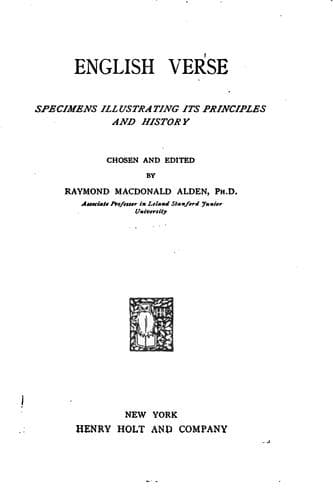
English Verse: Specimens Illustrating its Principles and HistoryAlden, Raymond MacDonald
General
English Verse: Specimens Illustrating its Principles and History
Alden, Raymond MacDonald
English language -- Versification; English poetry
Beyond the measure vast of thought,
The works the wizard Time has wrought!
The Gaul, 'tis held of antique story,
Saw Britain link'd to his now adverse strand;
No sea between, nor cliff sublime and hoary,
He pass'd with unwet feet thro' all our land.
To the blown Baltic then, they say,
The wild waves found another way,
Where Orcas howls, his wolfish mountains rounding;
Till all the banded West at once 'gan rise,
A wide wild storm ev'n Nature's self confounding,
With'ring her giant sons with strange uncouth surprise.
This pillar'd earth so firm and wide,
By winds and inward labors torn,
In thunders dread was push'd aside,
And down the should'ring billows borne.
And see, like gems, her laughing train,
The little isles on every side!
Mona, once hid from those who search the main,
Where thousand elfin shapes abide,
And Wight, who checks the west'ring tide;
For thee consenting Heaven has each bestowed,
A fair attendant on her sovereign pride.
To thee this blest divorce she ow'd,
For thou hast made her vales thy lov'd, thy last abode!
(COLLINS: _Ode to Liberty_, strophe and antistrophe. 1746.)
This ode consists of strophe, epode, antistrophe, and second epode. The
antistrophe corresponds metrically to the strophe, as usual; the epodes
are in four-stress couplets. It was Collins's habit to place the epode
between the strophe and antistrophe, perhaps, as Professor Bronson
suggests, in order that it may produce "an impression of its own
analogous to that of the Greek epode, namely, an impression of relief
and repose." Mr. Bronson says further of Collins's odes: "Collins was
less scholarly than Gray, but he was bolder and more original; and
consciously or unconsciously he so constructed his odes that their
organic parts stand out clearly distinct and produce effects analogous
to those produced by the Greek ode. In brief, his method was, first, to
make large divisions of the thought correspond to the large divisions of
the form; and, second, to throw out into relief the complex strophe and
antistrophe by contrasting them with a simple epode. The reader may not
perceive the minute correspondences in form between strophe and
antistrophe, but he can hardly fail to feel that the two answer to one
another in a general way." (Athenæum Press edition of Collins,
Introduction, p. lxxv.)
III^{1}
Public-domain text, read in full here on John Shaqi.
Reviews
Reviews
No reviews yet
Be the first to share your thoughts on this work.
Elsewhere in the archive
Join the Discussion
Join the discussion
Sign in to leave a comment or review.
Sign InorCreate an account