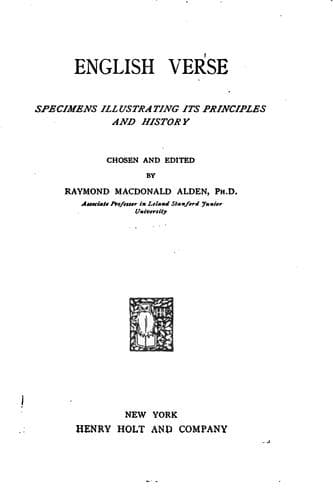
English Verse: Specimens Illustrating its Principles and HistoryAlden, Raymond MacDonald
General
English Verse: Specimens Illustrating its Principles and History
Alden, Raymond MacDonald
English language -- Versification; English poetry
Webbe prefaces his hexameters with a reference to those made by Gabriel
Harvey, and says: "I for my part, so farre as those examples would leade
me, and mine owne small skyll affoorde me, have blundered upon these
fewe; whereinto I have translated the two first Æglogues of Virgill:
because I thought no matter of my owne invention, nor any other of
antiquitye more fitte for tryal of thys thyng, before there were some
more speciall direction, which might leade to a lesse troublesome manner
of wryting." (Arber Reprint, p. 72.)
Thou, who roll'st in the firmament, round as the shield of my fathers,
Whence is thy girdle of glory, O Sun! and thy light everlasting?
Forth thou comest in thy awful beauty; the stars at thy rising
Haste to their azure pavilions; the moon sinks pale in the waters;
But thou movest alone; who dareth to wander beside thee?
Oaks of the mountains decay, and the hard oak crumbles asunder;
Ocean shrinks and again grows; lost is the moon from the heavens;
Whilst thou ever remainest the same to rejoice in thy brightness.
(WILLIAM TAYLOR: Paraphrase of _Ossian's Hymn to the Sun_. 1796.)
When English hexameters were revived at the end of the eighteenth
century, it was in good part under German influence. Bodmer, Klopstock,
and Voss, followed later by Goethe, made the German hexameter popular;
and William Taylor of Norwich, who in many ways helped to familiarize
his countrymen with German literature, became interested in the form. In
1796, the year of Goethe's _Hermann und Dorothea_, he contributed to the
_Monthly Magazine_ an article called "English Hexameters Exemplified,"
in which occurred the paraphrase from Ossian here quoted. Taylor pointed
out that the hexameter of the Germans was purely accentual. They were
"obliged, by the scarceness of long vowels and the rifeness of short
syllables in their language, to tolerate the frequent substitution of
trochees for spondees in their hexameter verse; and they scan, like
other modern nations, by emphasis, not by position." (Quoted in J. W.
Robberds's _Memoir of William Taylor of Norwich_, vol. i. pp. 157 ff.)
Most later writers of English hexameters have followed the line here
indicated, and have frankly abandoned the effort to represent the
quantities of classical prosody.
Earth! thou mother of numberless children, the nurse and the mother,
Sister thou of the stars, and beloved by the Sun, the rejoicer!
Guardian and friend of the moon, O Earth, whom the comets forget not,
Yea, in the measureless distance wheel round and again they behold thee!
Fadeless and young (and what if the latest birth of creation?)
Bride and consort of Heaven, that looks down upon thee enamoured!
(COLERIDGE: _Hymn to the Earth._ 1799.)
Coleridge made several experiments in hexameters at this time, and
planned, together with Southey, a long hexameter poem on Mohammed. To
Wordsworth he sent an experiment of the same kind in a lighter vein:
Public-domain text, read in full here on John Shaqi.
Reviews
Reviews
No reviews yet
Be the first to share your thoughts on this work.
Elsewhere in the archive
Join the Discussion
Join the discussion
Sign in to leave a comment or review.
Sign InorCreate an account