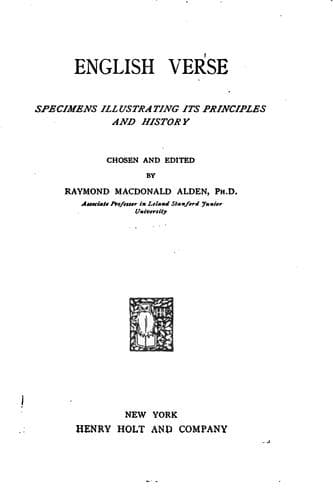
English Verse: Specimens Illustrating its Principles and HistoryAlden, Raymond MacDonald
General
English Verse: Specimens Illustrating its Principles and History
Alden, Raymond MacDonald
English language -- Versification; English poetry
_Evangeline_ is undoubtedly the most popular and widely read poem in
English hexameters, and may be said to have revived the vogue of the
measure in the middle of the nineteenth century. Yet its metrical
qualities have not pleased most careful critics. Matthew Arnold said
that the reception which the poem met with indicated that the dislike
for the metre "is rather among professional critics than among the
general public. Yet," he went on to say, "a version of Homer in
hexameters of the _Evangeline_ type would not satisfy the judicious, nor
is the definite establishment of this type to be desired." (_On
Translating Homer_, Macmillan ed., p. 284.) Mr. Arnold had previously
suggested that the "lumbering effect" of such hexameters as Longfellow's
is "caused by their being much too dactylic"; more spondees should be
introduced.
The editor of the Riverside edition of _Evangeline_ remarks
interestingly: "The measure lends itself easily to the lingering
melancholy which marks the greater part of the poem. The fall of the
verse at the end of the line and the sharp recovery at the beginning of
the next will be snares to the reader, who must beware of a jerking
style of delivery.... A little practice will enable one to acquire that
habit of reading the hexameter which we may liken, roughly, to the
climbing of a hill, resting a moment on the summit, and then descending
the other side."
Longfellow's hexameters were criticised most severely by his countryman,
Edgar Poe. Poe denied the possibility of any adequate representation of
the classical hexameter in English, largely because of the impossibility
of using English spondees. The only genuine hexameters he knew, he
declared, were some he had himself made, running:
"Do tell! when may we hope to make men of sense out of the Pundits,
Born and brought up with their snouts deep down in the mud of the
Frog-pond?"
(See Poe's Works, ed. Stedman and Woodberry, vol. vi. p. 104.)
Another interesting American experiment in hexameters is found in the
_Home Pastorals_ of Bayard Taylor (1869-1874). Taylor modeled his verses
after those of the Germans, particularly Goethe's in _Hermann und
Dorothea_. See, for example, the opening lines of _November_:
Public-domain text, read in full here on John Shaqi.
Reviews
Reviews
No reviews yet
Be the first to share your thoughts on this work.
Elsewhere in the archive
Join the Discussion
Join the discussion
Sign in to leave a comment or review.
Sign InorCreate an account