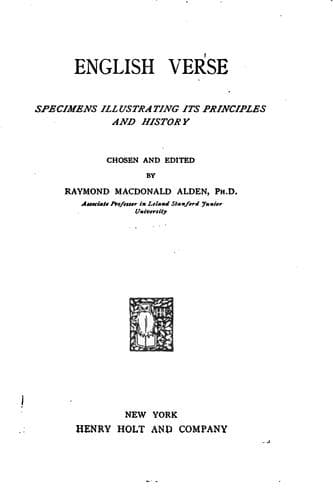
English Verse: Specimens Illustrating its Principles and HistoryAlden, Raymond MacDonald
General
English Verse: Specimens Illustrating its Principles and History
Alden, Raymond MacDonald
English language -- Versification; English poetry
It was Clough's hexameters, together with some "English Hexameter
Translations" by Dr. Hawtrey and Mr. Lockhart (1847), that chiefly
encouraged Matthew Arnold to believe that the measure might be well
adapted to a translation of Homer. "The hexameter, whether alone or with
the pentameter, possesses a movement, an expression, which no metre
hitherto in common use amongst us possesses, and which I am convinced
English poetry, as our mental wants multiply, will not always be content
to forego." (_Ib._, p. 210.) Mr. James Spedding replied to Mr. Arnold's
suggestion, from the point of view of the classical scholar, urging that
only hexameters purely quantitative could properly represent those of
Vergil. He illustrated his views by an amusing "hexametrical dialogue,"
conducted alternately in Vergilian measure and "in that of Longfellow."
Of the former are the lines:
"Verses so modulate, so tuned, so varied in accent,
Rich with unexpected changes, smooth, stately, sonorous,
Rolling ever forward, tidelike, with thunder, in endless
Procession, complex melodies--pause, quantity, accent,
After Virgilian precedent and practice, in order
Distributed--could these gratify th' Etonian ear-drum?"
(JAMES SPEDDING: _Reviews and Discussions_, 1879. p. 327.)
Arnold, however, wisely declined to be led into a discussion of the
relations of accent and quantity in English. "All we are here concerned
with," he said, "is the imitation, by the English hexameter, of the
ancient hexameter _in its effect upon us moderns_.... The received
English type, in its general outlines, is, for England, the necessary
given type of this metre; it is by rendering the metrical beat of its
pattern, not by rendering the accentual beat of it, that the English
language has adapted the Greek hexameter.... I look with hope towards
continued attempts at perfecting and employing this rhythm; but my
belief in the immediate success of such attempts is far less confident
than has been supposed." (See the whole passage, _On Translating Homer_,
pp. 275-284.)
The hexameters of Dr. Hawtrey, quoted by Arnold, are these:
Clearly the rest I behold of the dark-eyed sons of Achaia;
Known to me well are the faces of all; their names I remember;
Two, two only remain, whom I see not among the commanders,
Kastor fleet in the car,--Polydeukes brave with the cestus,--
Own dear brethren of mine,--one parent loved us as infants.
Are they not here in the host, from the shores of loved Lakedaimon,
Or, though they came with the rest in ships that bound through the waters,
Dare they not enter the fight or stand in the council of heroes,
All for fear of the shame and the taunts my crime has awakened?
--So said she. They long since in Earth's soft arms were reposing,
There, in their own dear land, their fatherland, Lakedaimon.
(From _English Hexameter Translations_, p. 242.)
Public-domain text, read in full here on John Shaqi.
Reviews
Reviews
No reviews yet
Be the first to share your thoughts on this work.
Elsewhere in the archive
Join the Discussion
Join the discussion
Sign in to leave a comment or review.
Sign InorCreate an account