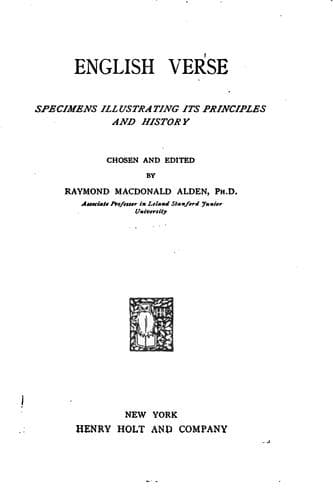
English Verse: Specimens Illustrating its Principles and HistoryAlden, Raymond MacDonald
General
English Verse: Specimens Illustrating its Principles and History
Alden, Raymond MacDonald
English language -- Versification; English poetry
[43] Campion's _Observations_ are reprinted in Mr. Bullen's edition of
his poems, and also in Rhys's _Literary Pamphlets_, vol. i. His attack
on the customary English rimed verse was answered by the poet laureate,
Samuel Daniel, who published in the same year (1602) his _Defence of
Ryme against a Pamphlet entituled Observations in the Art of English
Poesie_. "Wherein is demonstratively prooved that Ryme is the fittest
harmonie of words that comports with our Language." Daniel struck at the
root of all the principles of the classical versifiers,--the supreme
authority of the classics. "We are the children of nature as well as
they," he exclaims with reference to the ancients. "It is not the
observing of Trochaiques nor their Iambiques, that will make our
writings ought the wiser." And he expounds the English accentual
verse-system with clearness and vigor. This essay of Daniel's may be
said to mark the end, if it did not bring about the end, of the
Elizabethan experiments in classical metres. For other contemporary
criticism of the effort, see under the following section, on the
Hexameter.
[44] On the history of the English hexameter, see the admirable account
in Mayor's _Chapters on English Metre_, 2d ed., chap. xv.
[45] Southey's effort was attacked by the Rev. S. Tillbrook, Fellow of
Peterhouse, in a pamphlet entitled "Historical and Critical Remarks upon
the Modern Hexameters, and upon Mr. Southey's _Vision of Judgment_." To
this Southey replied in the second edition of his poem, saying to Mr.
Tillbrook: "You try the measure by Greek and Latin prosody: you might as
well try me by the Laws of Solon, or the Twelve Tables. I have
distinctly stated that the English hexameter is not constructed upon
those canons." He further appealed to the success of the hexameter in
Germany, and concluded: "I am glad that I have made the experiment, and
quite satisfied with the result. The critics who write and talk are with
you: so I dare say are the whole posse of schoolmasters. The women, the
young poets, and the _docile bairns_ are with me." (_Op. cit._, Preface
to the Present Edition, pp. xix, xxi.)
[46] For Kingsley's exposition of his theories, see the _Letters and
Memories_, edited by his wife, vol. i. pp. 338-344. He declined to yield
to "trocheism one atom. My ear always demands the equivalent of the
'lost short syllable.'" And again: "Every argument you bring convinces
me more and more that the theory of our prosody depending on accent is
false, and that it really is very nearly identical with the Greek.... I
am glad to hear (being a lazy man) that I have more license than I wish
for; but I do think that, with proper care, you may have as many
spondees, without hurting the rhythm, in English as you have in Greek,
and my ear is tortured by a trochee instead.... I must try for Homer's
average of a spondee a line."
VII. IMITATIONS OF ARTIFICIAL FRENCH LYRICAL FORMS
Public-domain text, read in full here on John Shaqi.
Reviews
Reviews
No reviews yet
Be the first to share your thoughts on this work.
Elsewhere in the archive
Join the Discussion
Join the discussion
Sign in to leave a comment or review.
Sign InorCreate an account