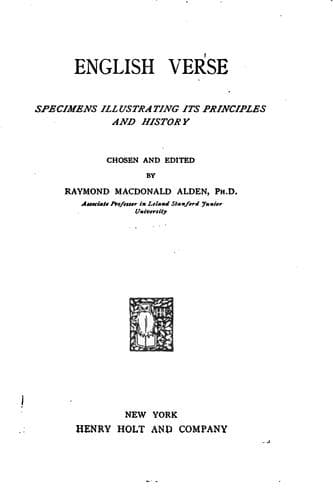
English Verse: Specimens Illustrating its Principles and HistoryAlden, Raymond MacDonald
General
English Verse: Specimens Illustrating its Principles and History
Alden, Raymond MacDonald
English language -- Versification; English poetry
There are times when a man must die.
Imagine for a battle-cry
From soldiers with a sword to hold--
From soldiers with the flag unrolled--
This coward's whine, this liar's lie,
"A man must live"!
(CHARLOTTE PERKINS STETSON: _A Man Must Live._)
A Roundel is wrought as a ring or a starbright sphere,
With craft of delight and with cunning of sound unsought,
That the heart of the hearer may smile if to pleasure his ear
A roundel is wrought.
Its jewel of music is carven of all or of aught--
Love, laughter, or mourning--remembrance of rapture or fear--
That fancy may fashion to hang in the ear of thought.
As a bird's quick song runs round, and the hearts in us hear--
Pause answers to pause, and again the same strain caught,
So moves the device whence, round as a pearl or tear,
A roundel is wrought.
(SWINBURNE: _The Roundel_, in _A Century of Roundels_.)
Mr. Swinburne has reintroduced the old word-form "roundel," to
distinguish this style of rondeau, of his own devising, with nine long
lines, riming _aba, bab, aba_, the refrain riming also with the _b_
lines.
C.--THE VILLANELLE
This highly intricate form was originally used for pastoral or idyllic
verse, and it is commonly reserved, as Mr. Dobson observes, for subjects
"full of sweetness and simplicity." In its typical form it consists of
nineteen lines, divided into five groups or stanzas of three and one of
four. There are but two rimes, and the two verses which constitute the
refrain recur again and again, line 1 reappearing as line 6, line 12,
and line 18, while line 3 reappears as line 9, line 15, and line 19. The
rime scheme of all the tercets is _aba_, of the conclusion _abaa_. Those
villanelles are considered most highly finished in which the refrain
recurs with slightly different significations.
On the history of this form, see J. Boulmier's _Les Villanelles_, Paris,
1878. The modern development of the villanelle has been largely
influenced by the work of Passerat (1534-1602), whose most famous
villanelle is the following specimen:
J'ay perdu ma tourterelle;
Est-ce-point elle que j'oy?
Je veux aller après elle.
Tu regrettes ta femelle;
Hélas! aussy fay-je moy:
J'ay perdu ma tourterelle.
Si ton amour est fidèle,
Aussy est ferme ma foy;
Je veux aller après elle.
Ta plainte se renouvelle?
Toujours plaindre je me doy:
J'ay perdu ma tourterelle.
En ne voyant plus la belle
Plus rien de beau je ne voy:
Je veux aller après elle.
Mort, que tant de fois j'apelle,
Prens ce que se donne à toy:
J'ai perdu ma tourterelle.
Je veux aller après elle.
(JEAN PASSERAT: _Villanelle._)
When I saw you last, Rose,
You were only so high;--
How fast the time goes!
Like a bud ere it blows,
You just peeped at the sky,
When I saw you last, Rose!
Public-domain text, read in full here on John Shaqi.
Reviews
Reviews
No reviews yet
Be the first to share your thoughts on this work.
Elsewhere in the archive
Join the Discussion
Join the discussion
Sign in to leave a comment or review.
Sign InorCreate an account