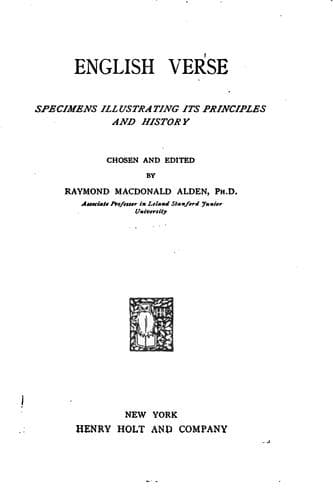
English Verse: Specimens Illustrating its Principles and HistoryAlden, Raymond MacDonald
General
English Verse: Specimens Illustrating its Principles and History
Alden, Raymond MacDonald
English language -- Versification; English poetry
The triolet is really a diminutive form of the Rondeau, and was not
originally distinguished by name. It consists of eight lines, with two
rimes, lines 1 and 2 recurring as lines 7 and 8, and line 1 also as line
4. The rime-scheme is _ABaAabAB_. Here, as in the villanelle, a change
of signification in the repeated lines is thought to add to the charm of
the form.
A French specimen, from Ranchin, is cited by Mr. Gleeson White as being
called by some "the king of triolets":
Le premier jour du mois de mai
Fut le plus heureux de ma vie:
Le beau dessein que je formai,
Le premier jour du mois de mai!
Je vous vis et je vous aimai.
Si ce dessein vous plut, Sylvie,
Le premier jour du mois de mai
Fut le plus heureux de ma vie.
Easy is the Triolet,
If you really learn to make it!
Once a neat refrain you get,
Easy is the Triolet.
As you see!--I pay my debt
With another rhyme. Deuce take it,
Easy is the Triolet,
If you really learn to make it!
(W. E. HENLEY.)
Rose kissed me to-day,
Will she kiss me to-morrow?
Let it be as it may,
Rose kissed me to-day.
But the pleasure gives way
To a savor of sorrow;--
Rose kissed me to-day,--
_Will_ she kiss me to-morrow?
I intended an Ode,
And it turned to a Sonnet.
It began _à la mode_,
I intended an Ode;
But Rose crossed the road
In her latest new bonnet.
I intended an Ode,
And it turned to a Sonnet.
(AUSTIN DOBSON: _Rose Leaves._)
In an earlier version of this last "rose-leaf" the ode is said to have
"turned into triolets," when Rose crossed the road "with a bunch of
fresh violets."
A little kiss when no one sees,
Where is the impropriety?
How sweet amid the birds and bees
A little kiss when no one sees!
Nor is it wrong, the world agrees,
If taken with sobriety.
A little kiss when no one sees,
Where is the impropriety?
(SAMUEL MINTURN PECK: _Under the Rose._)
Worldly designs, fears, hopes, farewell!
Farewell all earthly joys and cares!
On nobler thoughts my soul shall dwell!
Worldly designs, fears, hopes, farewell!
At quiet, in my peaceful cell,
I'll think on God, free from your snares;
Worldly designs, fears, hopes, farewell!
Farewell all earthly joys and cares!
(PATRICK CAREY: in _Trivial Poems and Triolets_, 1651; reprinted by
Scott, 1819; this triolet also quoted in _Ballades and Rondeaus_,
Introduction, p. xxxvi.)
Originally, the triolet was often used for serious sentiment. The
present and the following specimen are rare instances of its serious use
in English.
In his arms thy silly lamb
Lo! he gathers to his breast!
See, thou sadly bleating dam,
See him lift thy silly lamb!
Hear it cry, "How blest I am!--
Here is love and love is rest."
In his arms thy silly lamb
See him gather to his breast!
(GEORGE MACDONALD.)
E.--THE SESTINA
Public-domain text, read in full here on John Shaqi.
Reviews
Reviews
No reviews yet
Be the first to share your thoughts on this work.
Elsewhere in the archive
Join the Discussion
Join the discussion
Sign in to leave a comment or review.
Sign InorCreate an account