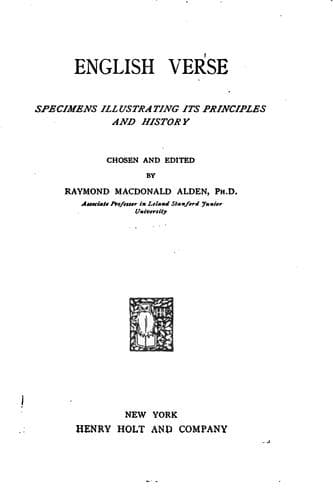
English Verse: Specimens Illustrating its Principles and HistoryAlden, Raymond MacDonald
General
English Verse: Specimens Illustrating its Principles and History
Alden, Raymond MacDonald
English language -- Versification; English poetry
Grass becomes flesh, one knows.
He grows like a bull of Bashan.
I am the grace he grows;
I startle his congregation.
He grows like a bull of Bashan,
One day he'll be Bishop or Dean.
I startle his congregation;
One day I shall preach to the Queen.
One day he'll be Bishop or Dean,
One of those science-haters;
One day I shall preach to the Queen.
To think of my going in gaiters!
One of those science-haters,
Blind as a mole or bat;
To think of my going in gaiters,
And wearing a shovel hat!
Blind as a mole or bat,
No faintest glimmer of light,
And wearing a shovel hat,
Morning and noon and night.
FOOTNOTES:
[47] On the early history of these forms in France, see Stengel's
article in Gröber's _Grundriss der Romanischen Philologie_. vol. ii. pp.
87-96.
[48] On these ballades of Graunson, a "knight of Savoy," see the
articles by A. Piaget, in _Romania_, vol. xix., and Lounsbury's _Studies
in Chaucer_, vol. iii. p. 450.
PART THREE
THE TIME-ELEMENT IN ENGLISH VERSE[49]
Nearly all modern writers on the theory of verse have admitted that
English words have no fixed syllabic quantities such as are postulated
for the classical languages, but that English quantities, so far as they
exist, are variable and (in part at least) subjective in character. To
this it is true there are exceptions, chiefly among the poets, like some
of those considered in the preceding section on Imitations of Classical
Metres.
Writers who have agreed that English words have no fixed quantities, are
still at variance as to the relation of the element of syllabic time to
the element of accent in English verse. Two extremes may at once be
distinguished: that represented by the familiar statement that our
rhythms differ from those of classical poetry in being based wholly on
accent, and that represented most notably by the late Sidney Lanier, who
held that syllabic time-values in English verse are as exact and regular
(hence as accurately measurable) as the notes of music. Lanier applied
his theory with admirable consistency, and represented all sorts of
English verse, even that of the Anglo-Saxon period, in musical notation.
He is almost universally regarded, however, as having been led by the
analogy between music and poetry to carry his method to quite impossible
lengths. The most characteristic example of this is his representation
of the familiar "blank verse" measure in "three-four" time, each
accented syllable being given a time-value twice as long as that of the
adjacent unaccented syllable--a method of reading which can easily be
shown to be contrary to all common practice. It should not be forgotten,
however, that a debt of gratitude is owed Mr. Lanier for having been one
of the first to emphasize adequately the fact that verse, like music, is
_rhythmical sound_.
Public-domain text, read in full here on John Shaqi.
Reviews
Reviews
No reviews yet
Be the first to share your thoughts on this work.
Elsewhere in the archive
Join the Discussion
Join the discussion
Sign in to leave a comment or review.
Sign InorCreate an account