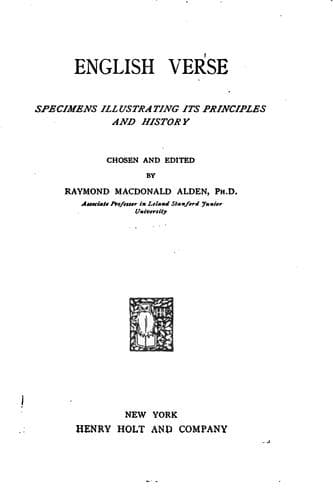
English Verse: Specimens Illustrating its Principles and HistoryAlden, Raymond MacDonald
General
English Verse: Specimens Illustrating its Principles and History
Alden, Raymond MacDonald
English language -- Versification; English poetry
It has already been observed that Mr. Lanier did good service in
emphasizing the analogy between music and poetry, but that he carried
the analogy too far. It may, therefore, be worth while to consider at
just this point the elements of likeness and of difference in the two
forms of art. Both are forms of _rhythmical_ art: music and verse are
alike rhythmical sound. Lanier showed with sufficient certainty that
rhythm is dependent upon both _time_ and _accent_. He said, to be sure,
that "time is _the_ essential" element;[50] but this does not seem to
have been altogether what he meant, for he himself pointed out that the
ear insistently marks off time-elements by the sense of variation of
stress, even when there is no real variation, as in the tick-tack of the
clock. He also pointed out that accent marks the rhythm of music quite
as truly as that of verse, the rule being that ordinarily the first note
of each measure shall receive a special stress. It seems, then, that the
rhythm of music is based on the recurrence of accented sounds at equal
time-intervals. The same thing is true of the rhythm of verse. For every
kind of metre there is a normal verse-rhythm which is present in the
mind as the basis on which the verse is built up, no matter how many
variations may constantly occur. This normal rhythm is formed by a
succession of accents at exactly equal time-intervals,[51] such as can
be marked off by a metronome, or by the mechanical beating of the foot
on the floor. We realize that the verse as commonly read frequently
departs from this regularity of intervals; but without the regularity as
a norm to which to refer it, we should not recognize it as verse. The
normal accent-interval we call a "foot."
Public-domain text, read in full here on John Shaqi.
Reviews
Reviews
No reviews yet
Be the first to share your thoughts on this work.
Elsewhere in the archive
Join the Discussion
Join the discussion
Sign in to leave a comment or review.
Sign InorCreate an account