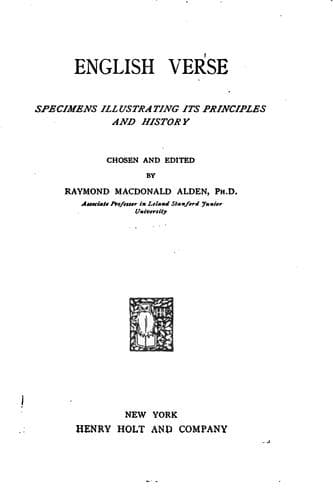
English Verse: Specimens Illustrating its Principles and HistoryAlden, Raymond MacDonald
General
English Verse: Specimens Illustrating its Principles and History
Alden, Raymond MacDonald
English language -- Versification; English poetry
There is, then, a unit of time on which all verse-rhythms, like all
musical rhythms, are based; and this is what we commonly call in music
the _measure_, and in verse, the _foot_, I shall recur to this matter a
little later in considering the terminology of the subject; for the
present let us return to the relations of verse and music. Both, we have
seen, are based on the recurrence of accented sounds at equal
time-intervals. There is some difference, however, in the emphasis which
one naturally places on the respective parts of the statement. In music
we feel that the fact of chief importance is that the measures shall be
equal in time, while the recurring accent seems a mere means of marking
this equality; but in verse we feel that the chief fact is that the
accents shall recur, the equality of time-intervals being in a sense a
secondary source of pleasure. In music, therefore, as we have seen, we
treat departures from regularity of time-intervals as somewhat more
exceptional than in verse. But the rhythm would suffer, would even
disappear, were either element wholly removed.
If we look for further distinctions between verse and music, we find
them in the separate sounds which go to make up the unit-measures. Not
only are the measures of music of mathematically equal length, but all
the sounds bear exact time-relations to each other: each is either half
as long, or twice as long, or a quarter as long, or four times as long,
as its neighbor. On the other hand, the number of separate sounds in the
measure constantly varies; it is sufficient that the total length be
that of the full measure. In verse these conditions are reversed. The
separate syllables, while they doubtless vary in length, are not
mathematically coördinated as to duration by the ordinary reader. It is
almost as difficult to say just what the time-relation of any two
adjacent syllables is, as to be sure that one is stressed just twice as
strongly as the other. On the other hand, the _number_ of syllables in
the foot (in good modern English verse) is tolerably constant.
For the sake of completeness, one may add two other fundamental
distinctions which, _apart_ from the elements of rhythm, differentiate
verse from music. Music, apart from rhythm, characteristically depends
on variation of pitch, and only incidentally (as in the case of the use
of different instruments in orchestration) on variation of
sound-quality; whereas verse, apart from rhythm, characteristically
depends on variation of sound-quality,--that is, on the different sounds
of the different words,--and only incidentally on changes of pitch.
Finally, the changing sounds of music are only vaguely symbolic, while
the changing sounds of verse are symbolic of definite ideas.
For the sake of easy comparison we may put these observations in a rough
sort of table:
MUSIC VERSE
_Rhythmical Sound_,
i.e.
Public-domain text, read in full here on John Shaqi.
Reviews
Reviews
No reviews yet
Be the first to share your thoughts on this work.
Elsewhere in the archive
Join the Discussion
Join the discussion
Sign in to leave a comment or review.
Sign InorCreate an account