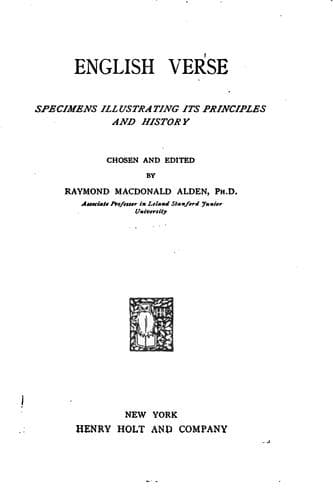
English Verse: Specimens Illustrating its Principles and HistoryAlden, Raymond MacDonald
General
English Verse: Specimens Illustrating its Principles and History
Alden, Raymond MacDonald
English language -- Versification; English poetry
always a favorite specimen for metrists to dissect, is of like
character. Mr. Robertson, in the essay already cited, makes considerable
use of this verse as showing the vanity of the usual method of dividing
verses into equal feet. He quotes approvingly Professor Shairp's account
of the way in which Clough analyzed the line: "The two feet 'first
disobe-' took up the time of four syllables, two iambic feet: the voice
rested awhile on the word 'first'; then passed swiftly over 'diso-,'
then rested again on 'be-' so as to recover the previous hurry." Now
this seems to be merely a description of the way in which the words
would be uttered in prose, and to neglect the rhythm of the poem in
which they stand. In the second foot one can and should give the
syllable _dis-_ full syllabic time, instead of hurrying over it as in
prose speech,--a rendering made easy by the fact that it frequently has
a marked secondary accent. Conversely, one can give _first_ somewhat
less time than it would occupy in prose, without thereby diminishing
its accent. The word _and_, in the fourth foot, would in prose utterance
be allowed almost no time-value; and it may be treated in the same way
in the verse, by permitting the pause at the comma to fill up the normal
time of the foot. It would seem to be better, however, to give _and_ a
fairly distinct utterance for metrical purposes (without, of course,
adding any stress), and thus to approach more closely to the scheme of
time-intervals. It is highly improbable that any one would read this
verse--or almost any other verse of _Paradise Lost_--with such exact
observance of the equal time-intervals as would appear in regular
lyrical poetry. We have already seen that blank verse departs more
constantly from the typical scheme of the measure than any other of our
verse-forms. Nevertheless, the reader with a well-trained ear listens
always for the flow of the typical metre underneath the surface
irregularities, and, by a delicate adjustment of syllable-lengths, can
bring the poet's words into far more rhythmical utterance than they
would find in prose.
There is one other method of varying the time-elements in verse which
has already been suggested by what was said of the pause at the comma in
the line of _Paradise Lost_. It will be seen very generally that light
syllables, such as one wishes to utter in brief periods of time, are
found on either side of the phrase-pauses in our verse.
"The first in valor, as the first in place"
is a typical line in this respect. The natural pause, indicated by the
comma, takes up part of the time of the third foot, which there are no
syllables fitted wholly to fill. It might almost be said that, in
ordinary five-stress verse, such verses are quite as numerous as those
with five complete feet. The pause satisfies the ear, so far as the
time-intervals are concerned, quite as well as a long syllable.
Public-domain text, read in full here on John Shaqi.
Reviews
Reviews
No reviews yet
Be the first to share your thoughts on this work.
Elsewhere in the archive
Join the Discussion
Join the discussion
Sign in to leave a comment or review.
Sign InorCreate an account