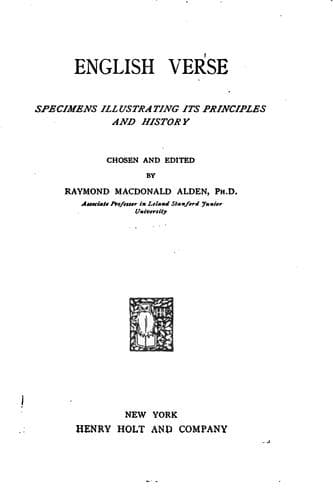
English Verse: Specimens Illustrating its Principles and HistoryAlden, Raymond MacDonald
General
English Verse: Specimens Illustrating its Principles and History
Alden, Raymond MacDonald
English language -- Versification; English poetry
It is quite possible that these laws might be stated more fully and
definitely. In Anglo-Saxon verse the conditions were perhaps not so
different from those of modern English as we are likely to think; there
we know that the principal stresses of the verse always fell on long
syllables, and scholars like Sievers, by analyzing the remains of our
early poetry, have formulated certain other laws as to the position and
relations of the short syllables. If similar laws were to be formulated
for our modern verse, we should probably find them no more perplexing
than our ancestors would find those we have formulated for their verse.
In every case the "law" is only an attempt to express what the ear has
long known and obeyed. Mr. Goodell, in an article on "Quantity in
English Verse," in the _Proceedings of the American Philological
Society_ for 1885, attempted to do for our verse what has just been
suggested. He stated such laws as these:
"The thesis becomes a triseme if the next syllable bears the ictus. No
syllable can be placed in this position which is incapable of
prolongation."
"If the arsis is monosyllabic, a short vowel in the thesis followed by a
single consonant is not lengthened by the ictus; the arsis is instead
prolonged."
"With arsis monosyllabic, the strong tendency is to make the thesis
short."
Perhaps these rules are on the right track; the terminology is somewhat
difficult, and makes one hesitate to criticise carefully. But since, as
we have seen, the terms "long" and "short," as applied to English
syllables, have come to be so purely relative, since our syllabic
quantities vary so much at the will of the reader, and since the whole
matter of the reading of our verse is in good measure one of subjective
interpretation, it seems very doubtful whether any statements more
explicit than those already laid down would be found of practical
service.
Public-domain text, read in full here on John Shaqi.
Reviews
Reviews
No reviews yet
Be the first to share your thoughts on this work.
Elsewhere in the archive
Join the Discussion
Join the discussion
Sign in to leave a comment or review.
Sign InorCreate an account