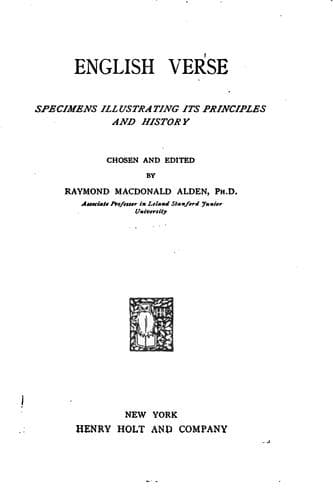
English Verse: Specimens Illustrating its Principles and HistoryAlden, Raymond MacDonald
General
English Verse: Specimens Illustrating its Principles and History
Alden, Raymond MacDonald
English language -- Versification; English poetry
Why do we so often find men in these days, either using metre ... where
they ought to have expressed themselves in prose, or expressing
themselves in verse in a style so far remote from the standard of
diction established in society that they fail to touch the heart? I
think the explanation of this curious phenomenon is that, though metre
can only properly be used for the expression of universal ideas, there
is in modern society an eccentric or monastic principle at work, which
leads men to pervert metre into a luxurious instrument for the
expression of merely private ideas.
(WILLIAM JOHN COURTHOPE: _Life in Poetry, Law in Taste_, pp. 71-83.)
Language is colloquial and declarative in our ordinary speech, and on
its legs for common use and movement. Only when it takes wings does it
become poetry. As the poet, touched by emotion, rises to enthusiasm and
imaginative power or skill, his speech grows _rhythmic_, and thus puts
on the attribute that distinguishes it from every other mode of artistic
expression--the guild-mark which, rightly considered, establishes the
nature of the thing itself.... Our new empiricism, following where
intuition leads the way, comprehends the function of _vibrations_: it
perceives that every movement of matter, seized upon by universal force,
is _vibratory_; that vibrations, and nothing else, convey through the
body the look and voice of nature to the soul; that thus alone can one
incarnate individuality address its fellow; that, to use old Bunyan's
imagery, these vibrations knock at the ear-gate, and are visible to the
eye-gate, and are sentient at the gates of touch of the living temple.
The word describing their action is in evidence; they "thrill" the body,
they thrill the soul, both of which respond with subjective,
interblending vibrations, according to the keys, the wave-lengths, of
their excitants. Thus it is absolutely true that what Buxton Forman
calls "idealized language,"--that is, speech which is imaginative and
rhythmical,--goes with emotional thought; and that words exert a
mysterious and potent influence, thus chosen and assorted, beyond their
normal meanings....
Public-domain text, read in full here on John Shaqi.
Reviews
Reviews
No reviews yet
Be the first to share your thoughts on this work.
Elsewhere in the archive
Join the Discussion
Join the discussion
Sign in to leave a comment or review.
Sign InorCreate an account