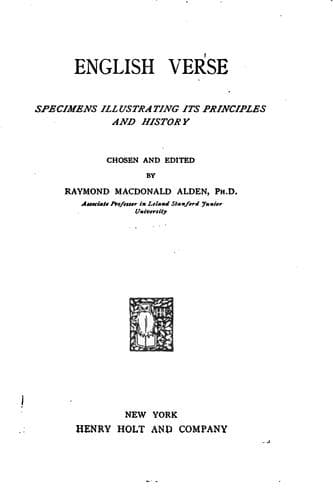
English Verse: Specimens Illustrating its Principles and HistoryAlden, Raymond MacDonald
General
English Verse: Specimens Illustrating its Principles and History
Alden, Raymond MacDonald
English language -- Versification; English poetry
According to Stengel (in Gröber's _Grundriss der Romanischen
Philologie_), this octosyllabic French verse goes back to a lost
vulgar Latin verse; this view is opposed by Dr. C. M. Lewis, in his
_Foreign Sources of Modern English Versification_ (Yale Studies in
English, 1898), who finds its origin in the tetrameter of the Latin
hymns. Dr. Lewis also attributes to this Latin verse more direct
influence on English verse than is commonly assumed. Thus he finds
in it, rather than in the French octosyllabics, the model of the
verse of the _Pater Noster_, quoted below. The argument is briefly
this: the Latin verse was both accentual and syllabic; the French
verse was syllabic but not accentual; that of the _Pater Noster_ is
accentual but not syllabic; hence it is more nearly like the Latin
than the French. A stanza of the Latin tetrameter, cited by Dr.
Lewis from the hymn _Aurora lucis rutilat_, is as follows:
"Tristes erat apostoli
de nece sui Domini,
quem pœna mortis crudeli
servi damnarunt impii."
Compare these lines from the _Brut_ of Wace:
"Adunt apela Cordeille
qui esteit sa plus joes ne fille;
pur ce que il l'aveit plus chiere
que Ragaü ne la premiere
quida que el e cuneüst
que plus chier des al tres l'eüst.
Cordeil le out bien escuté
et bien out en sun cuer noté
cument ses deus sorurs parloënt,
cument lur pere losengoënt."
Public-domain text, read in full here on John Shaqi.
Reviews
Reviews
No reviews yet
Be the first to share your thoughts on this work.
Elsewhere in the archive
Join the Discussion
Join the discussion
Sign in to leave a comment or review.
Sign InorCreate an account