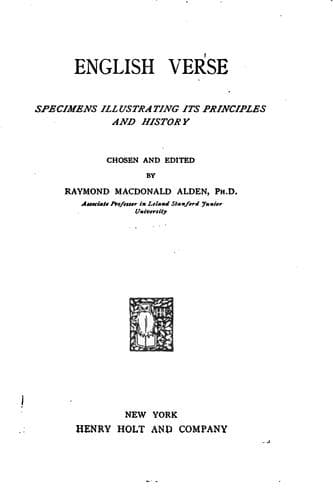
English Verse: Specimens Illustrating its Principles and HistoryAlden, Raymond MacDonald
General
English Verse: Specimens Illustrating its Principles and History
Alden, Raymond MacDonald
English language -- Versification; English poetry
How deep yon azure dyes the sky,
Where orbs of gold unnumber'd lie,
While through their ranks in silver pride
The nether crescent seems to glide!
The slumbering breeze forgets to breathe,
The lake is smooth and clear beneath,
Where once again the spangled show
Descends to meet our eyes below.
The grounds which on the right aspire,
In dimness from the view retire:
The left presents a place of graves,
Whose wall the silent water laves.
That steeple guides thy doubtful sight
Among the livid gleams of night.
There pass, with melancholy state,
By all the solemn heaps of fate,
And think, as softly-sad you tread
Above the venerable dead,
'Time was, like thee they life possest,
And time shalt be, that thou shalt rest.'
(THOMAS PARNELL: _A Night-Piece on Death_, ab. 1715.)
Mr. Gosse speaks of Parnell's employment of the octosyllabic couplet in
this poem as "wonderfully subtle and harmonious." (_Eighteenth Century
Literature_, p. 137.)
A Hare who, in a civil way,
Complied with everything, like Gay,
Was known by all the bestial train
Who haunt the wood, or graze the plain.
Her care was never to offend,
And every creature was her friend.
As forth she went at early dawn,
To taste the dew-besprinkled lawn,
Behind she hears the hunter's cries,
And from the deep-mouthed thunder flies:
She starts, she stops, she pants for breath;
She hears the near advance of death;
She doubles, to mislead the hound,
And measures back her mazy round:
Till, fainting in the public way,
Half dead with fear she gasping lay.
(JOHN GAY: _The Hare and Many Friends_, in _Fables_. 1727.)
Gay's use of the short couplet in his _Fables_ sometimes shows it at its
best for narrative purposes.
My female friends, whose tender hearts
Have better learned to act their parts,
Receive the news in doleful dumps:
'The Dean is dead: (Pray what is trumps?)
Then, Lord have mercy on his soul!
(Ladies, I'll venture for the vole.)
Six Deans, they say, must bear the pall:
(I wish I knew what king to call).
Madam, your husband will attend
The funeral of so good a friend?
No, madam, 'tis a shocking sight:
And he's engaged to-morrow night:
My Lady Club will take it ill,
If he should fail her at quadrille.
He loved the Dean--(I lead a heart)
But dearest friends, they say, must part.
His time was come: he ran his race;
We hope he's in a better place.'
(SWIFT: _On the Death of Dr. Swift._ 1731.)
Swift made use of the octosyllabic couplet in nearly all his verse, and
with no little vigor and originality. Mr. Gosse remarks: "His lines fall
like well-directed blows of the flail, and he gives the octosyllabic
measure, which he is accustomed to choose on account of the Hudibrastic
opportunities it offers, a character which is entirely his own."
(_Eighteenth Century Literature_, p. 153.)
Public-domain text, read in full here on John Shaqi.
Reviews
Reviews
No reviews yet
Be the first to share your thoughts on this work.
Elsewhere in the archive
Join the Discussion
Join the discussion
Sign in to leave a comment or review.
Sign InorCreate an account