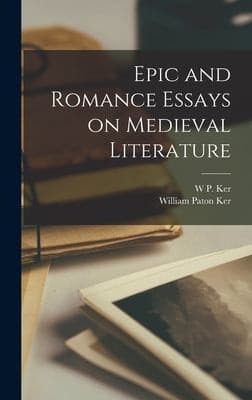
Epic and Romance: Essays on Medieval LiteratureKer, W. P. (William Paton)
History
Epic and Romance: Essays on Medieval Literature
Ker, W. P. (William Paton)
Epic poetry -- History and criticism; Literature, Medieval -- History and criticism; Romances -- History and criticism
effect of the romantic interludes in _Gisli_, which is perhaps the
most tragic of all the Sagas, or at any rate the most self-conscious
of its tragic aim. In the story of Gisli there is an introduction and
preparation, but there is no very great expense of historical
preliminaries. The discrepancies here between the two extant
redactions of the Saga seem to show that introductory chapters of this
sort were regarded as fair openings for invention and decoration by
editors, who had wits enough to leave the essential part of the story
very much to itself. Here, when once the action has begun, it goes on
to the end without a fault. The chief characters are presented at the
beginning; Gisli and Thorkell his brother; Thorgrim the Priest and
Vestein, their two brothers-in-law. A speech foretelling their
disunion is reported to Gisli, and leads him to propose the oath of
fellowship between the four; which proposal, meant to avert the omen,
brings about its fulfilment. And so the story goes on logically and
inevitably to the death of Gisli, who slew Thorgrim, and the
passionate agony of Thordis, Thorgrim's wife and Gisli's sister.
_Hrafnkels Saga_ is a tragic idyll, complete and rounded. It is
different in its design from _Njála_ or _Laxdæla_, from the stories of
Grettir and Gisli. It is a short story, well concentrated. For mere
symmetry of design it might compete with any of the greater Icelandic
works, not to speak of any modern fiction.
Hrafnkel, the proud man, did a cruel thing "for his oath's sake";
killed his shepherd Einar for riding on Freyfaxi, the horse that
belonged to Frey the god, and to Hrafnkel his priest. To the father of
Einar he made offers of compensation which were not accepted. Then the
story, with much admirable detail (especially in the scenes at the
Althing), goes on to show how Hrafnkel's pride was humbled by Einar's
cousin. All through, however, Hrafnkel is represented as guilty of
tragic terror, not of wickedness; he is punished more than is due, and
in the end the balance is redressed, and his arrogant conqueror is
made to accept Hrafnkel's terms. It is a story clearly and
symmetrically composed; it would be too neat, indeed, if it were not
that it still leaves some accounts outstanding at the end: the
original error is wasteful, and the life of an innocent man is
sacrificed in the clearing of scores between Hrafnkel and his
adversary.
Public-domain text, read in full here on John Shaqi.
Reviews
Reviews
No reviews yet
Be the first to share your thoughts on this work.
Elsewhere in the archive
Join the Discussion
Join the discussion
Sign in to leave a comment or review.
Sign InorCreate an account