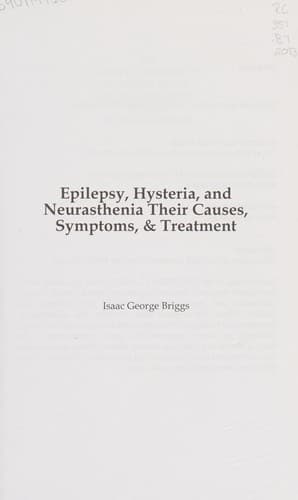
Epilepsy, Hysteria, and Neurasthenia: Their Causes, Symptoms, & TreatmentBriggs, Isaac George
Science
Epilepsy, Hysteria, and Neurasthenia: Their Causes, Symptoms, & Treatment
Briggs, Isaac George
Epilepsy; Hysteria; Nervous system -- Diseases; Neurasthenia
If the son becomes a toper, therefore, it is because he, like his father
before him, was born with a defect--weak control--which might have made of
him a drug-fiend, a tobacco-slave, a rake, or a criminal; in his home drink
would naturally be the temptation nearest to hand, and he would show his
lack of control in drunkenness.
The way a lily-seed is treated makes a vast difference to the plant which
arises. If sown in poor soil, and neglected, a dwarf, sickly plant will
result; if sown in rich soil, and given every care that enthusiasm, money
and skill can suggest or procure, the result will be magnificent.
So with man. A well-nourished mother, free from care and disease, may have
a finer child than a half-starved woman, crushed by worry and work, but
neither starvation nor nourishment alter the inborn character of the child.
The _body-cells_ are greatly changed by disease, poison, injury, and
overwork, but these changes are not passed on, and despite the influence of
disease from time immemorial, the _germ-cell_ produces the same man as in
ancient days. Without this fixity of character, this "continuity of the
germ-plasm", "man" would cease to be, for the descendants of changeable
cells would be of infinite variety, having fixity of neither form nor
character.
Epilepsy, hysteria and neurasthenia are all outward signs of defect in the
germ-plasm, and so they (or a predisposition to them) can be passed on, and
inherited.
If a man shows a certain character, his plasm, had, and has, the causative
factor. He may have received it from _both_ his parents, when it will be
_strong_, or from one only, when it will be _normal_. If he have it not, it
is absent. The same applies to the plasm of the woman he mates, so there
are six possible combinations, with results according to "Mendel's Law."
_All_ the children will not inherit a taint unless _both_ parents possess
it, but, however strong one parent be, if the other is tainted, _none_ of
the children can be absolutely clean, but will show the taint, weak,
strong, or dormant. This means that neuropathy will recur--and that it has
previously occurred--in the same family, unless there be continual mating
into sound stocks. If there is continual mating into bad stocks, it will
recur frequently and in severe forms. All intermediate stages may occur,
depending entirely on the qualities of the combining stocks.
From this we shall expect, in the same stock, signs of neuropathic taint
other than the three diseases dealt with here, and these we get; for
alcoholism, criminality, chorea, deformities, insanity and other brain
diseases, are not infrequent among the relatives of a neuropath, showing
that the family germ-plasm is unsound.
Public-domain text, read in full here on John Shaqi.
Reviews
Reviews
No reviews yet
Be the first to share your thoughts on this work.
Elsewhere in the archive
Join the Discussion
Join the discussion
Sign in to leave a comment or review.
Sign InorCreate an account