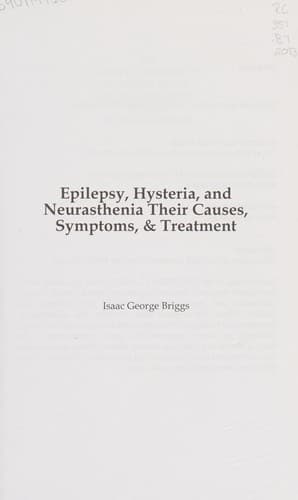
Epilepsy, Hysteria, and Neurasthenia: Their Causes, Symptoms, & TreatmentBriggs, Isaac George
Science
Epilepsy, Hysteria, and Neurasthenia: Their Causes, Symptoms, & Treatment
Briggs, Isaac George
Epilepsy; Hysteria; Nervous system -- Diseases; Neurasthenia
Now the performance of the act judged is directed by the performer's brain,
the constitution of which was pre-determined by the germ-plasm from which
he arose, so that _the basis of character is inherited_.
The moral sense is the last evolved and least stable attribute of the last
evolved and least stable of our organs, the brain; and brains are born, not
made to order. To blame a man for having weak control--a sick will--is as
unreasonable as to blame him for a cleft palate or a squint. The "good"
people who jog so quietly through life little reck how much they owe their
ancestors, from whom they received stability.
These tendencies represent the total material for building character.
Training and environment can only nourish good tendencies and give bad ones
no encouragement to grow gigantic.
If training and environment alone formed character, then children reared
together would be of similar disposition; by no means the case. Similarly,
if external influences altered inborn tendencies, then, not only would the
evil man be totally reformed by strong inducements to virtue, but strong
inducements to vice would lead totally astray the good man, for "good" is
no _stronger_ than "evil", both being attributes of mind.
In mind as in body, from the moment he is conceived to the moment his dust
rests in the tomb, man is directed by immutable laws, though he is not
simply a machine directed by impulses over which he has no control. There
is real meaning in "strong will" and "weak will" will being a tendency to
deliberate before and be steadfast in action, a tendency which varies
immensely in different people. The fallacy of "free will" lies in assuming
that every one has this tendency equally developed, making character a mere
matter of saying "Yes!" and "No!" without reference to the individual's
mental make-up.
Deliberate, persistent wickedness implies a strong will, just what
neuropaths lack. A man of weak will can never be a very good nor yet a very
bad man. He will be very good at times, very bad at times, and neutral at
times, but neither for long; before sudden impulses, whether good or bad,
neuropaths are largely powerless.
The many perversities of a neuropath are not deliberately put forth of his
"free will" to annoy both himself and others, for the neuropath inherits
his weak-control no less than his large hands.
Friends _must_ remember they are dealing with a person whose _nature_ it is
to "go off half-cock", and who cannot be normal "if he likes". The
neuropath, young or old, says what he "thinks" _without thinking_, that is
he says what he _feels_, and acts hastily without weighing consequences.
_Cassius_: Have you not love enough to bear with me,
When that rash humour which my mother gave me
Makes me forgetful?
_Brutus_: Yes, Cassius; and, from henceforth
When you are over-earnest with your Brutus,
He'll think your mother chides, and leave you so.
* * * * *
Public-domain text, read in full here on John Shaqi.
Reviews
Reviews
No reviews yet
Be the first to share your thoughts on this work.
Elsewhere in the archive
Join the Discussion
Join the discussion
Sign in to leave a comment or review.
Sign InorCreate an account