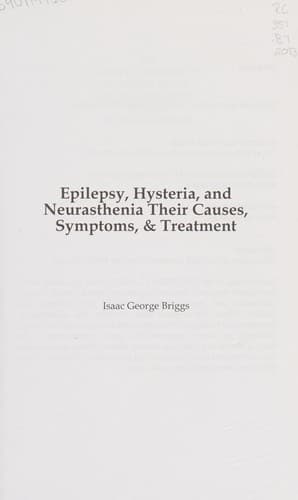
Epilepsy, Hysteria, and Neurasthenia: Their Causes, Symptoms, & TreatmentBriggs, Isaac George
Science
Epilepsy, Hysteria, and Neurasthenia: Their Causes, Symptoms, & Treatment
Briggs, Isaac George
Epilepsy; Hysteria; Nervous system -- Diseases; Neurasthenia
They are ready to forgive when there is magnanimity, vainglory and probably
folly in forgiveness, but will not overlook the most trivial affront when
there is every reason for so doing. They have brain, but not ballast, and
their whole life is usually a lopsided effort to "play to the gallery".
In poetry and literature, fancy has free play, and they often succeed,
sometimes rising to sublime heights; usually in the depiction of the
whimsical, the wonderful, the sardonic, the bizarre, the monstrous, or the
frankly impossible. They are not architects as much as jugglers of words,
and descriptive writing from an acute angle of vision is their forte. They
sometimes succeed as artists or composers, for in these spheres they need
not elaborate their ideas in such clean-cut detail, but many who might
succeed in these branches have not sufficient strength of purpose to do the
preliminary "spadework".
They have too many talents, too many differing inclinations, too much
impetuosity, too much vanity, too little concentration and will-power, and
they fail in ordinary walks of life from the lack of resolution to lay the
foundations necessary to successful mediocrity.
No greater obstacle to progress exists than the reputation for talent which
this class acquire on a flimsy basis of superficial brilliance in
conversation or a penchant for witty repartee. They are self-opinionated
and egoistical, with a conceit and assurance out of all proportion to their
abilities. Their mental perspective is distorted and they are conspicuous
for their obstinacy. In conversation they are prolix and pretentious, and
they often contract religious mania, in which their actions by no means
accord with their protestations, for they have very elementary notions of
right and wrong, or no notions at all.
Often they are precocious, but untruthful, cruel, and vicious; the despair
of relatives, friends, and teachers. They combine unusual frankness with an
audacity and impulsiveness that is very misleading, for below this show of
fire and power there is no stability.
Their character is a tangle of mercurial moods, the neuropath being
passionate but loving, sullen one moment, overflowing with sentimental
affection the next, vicious a little while later, quick to unreasoning
anger, and as quick to repent or forgive, obstinate but easily led,
versatile but inconstant, noble and mean by turns, full of contradictions
and contrasts, at best a brilliant failure, vain, deaf to advice or
reproof, having in his ailing frame the virtues and vices of a dozen normal
men.
Mercier aptly describes him:
Public-domain text, read in full here on John Shaqi.
Reviews
Reviews
No reviews yet
Be the first to share your thoughts on this work.
Elsewhere in the archive
Join the Discussion
Join the discussion
Sign in to leave a comment or review.
Sign InorCreate an account