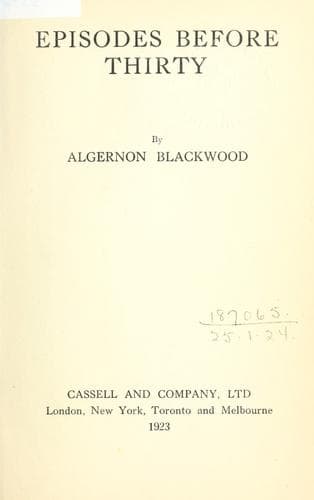
Authors, English -- 20th century -- Biography; Blackwood, Algernon, 1869-1951
But what really alarmed me most was my inside knowledge of New York
justice. I had seen too many innocent men sent up; I had heard faked
evidence in too many police cases; I knew that, without a “pull,” I
stood but little chance of escaping a conviction as an accessory
to what they would call a wanton case of arson. I was not even on
the staff of a newspaper at the time. I had no influence of any sort
behind me. Nor were my means of support too “visible,” a Britisher,
a highly-connected Britisher into the bargain, it was just what the
new-broom fire marshal was looking for. It would make a big case for
the Press. The agony of mind I endured was ghastly, and the slow delay
of long waiting intensified it.... One evening, on coming home about
dusk, I saw a strange man in the little hall-way of my house. He asked
me my name. I told him. He handed me a blue paper and went out. It was
the long-expected subpœna from the fire marshal. I was summoned to
attend at eight o’clock two mornings later in his office.
My emotions that night and the next day were new experiences to me; I
heard the judge sentence me, saw myself in prison for a term of years
with hard labour. I began to _feel_ guilty. I knew I should say the
wrong thing to the fire marshal. I should convict myself. The truth
was the truth, but everything pointed against me; I knew Brodie as a
friend, I was his business associate, was frequently in his rooms, had
accepted kindnesses from him, I needed money badly, I had hidden his
good clothes in my cupboards a few days before the fire. I had been
with him on that particular night, I had left the room with him--last
of the party. I should be looked upon as guilty, it was for me to
clear myself. Prejudice against me, too, as an Englishman would be
strong. The Boyde episode would be revived, and twisted to show that I
consorted with law-breakers. I should stammer and hesitate and appear
to be hiding the truth, to be lying, and I should most certainly look
guilty. The thing I dreaded had come upon me. I thought of my home and
family.
It all made me realize with a fresh sharpness the kind of world poverty
had dragged me down to, with the contrast between what I had been
born to and what I now lived in.... I needed every scrap of strength
and comfort my books could give me. That I was exaggerating like
a schoolboy never occurred to me. I suffered the tortures of the
damned, of the already condemned, at any rate. That I was innocent of
wrong-doing was, for some reason, no consolation: I had got myself into
an awful mess and should have to pay the price.
Public-domain text, read in full here on John Shaqi.
Reviews
Reviews
No reviews yet
Be the first to share your thoughts on this work.
Elsewhere in the archive
Join the Discussion
Join the discussion
Sign in to leave a comment or review.
Sign InorCreate an account