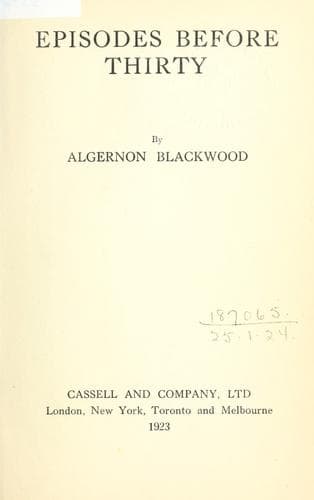
Authors, English -- 20th century -- Biography; Blackwood, Algernon, 1869-1951
To live consciously is to register impressions; some receive many more
of these per second than others, and thus enjoy an intenser and more
varied life. The two-per-second mind finds the two-per-minute one slow,
dull and stupid. Kay, anyhow, didn’t “mind” things much, circumstances
never troubled him, whereas Boyde and I minded them acutely. I envied
Kay’s power of sleeping calmly in that bed, careless of night-attacks
until they actually came. The horror of New York, similarly, that was
creeping into my blood had hardly touched him, though it certainly
had infected Boyde. In my own make-up lay something ultra-sensitive
that took impressions far too easily. Not only did it vibrate with
unnecessary eagerness to every change in sky and sea, but to every
shade of attitude and manner in my fellows as well. I seemed covered
with sore and tender places into which New York rubbed salt and acid
every hour of the day. It wounded, not alone because I felt unhappy,
but of itself. It hit me where it pleased. The awful city, with its
torrential, headlong life, held for me something of the monstrous.
Everything about it was exaggerated. Its racing speed, its roofs amid
the clouds with the canyon gulfs below, its gaudy avenues dripping
gold that ran almost arm in arm with streets little better than
sewers of human decay and misery, its frantic noise, both of voices
and mechanism, its lavishly organized charity and boastful splendour,
and its deep corruption in the grip of a heartless and degraded
Tammany--it was all this that painted the horror into my imagination
as of something monstrous, non-human, almost unearthly. It became, for
me, a scab on the skin of the planet, brilliant with the hues of fever,
moving all over with its teeming microbes. I felt it, indeed, but half
civilized.
This note of how I felt in these--my early years--rose up again the
other day, as I read what O. Henry wrote to his outlaw friend from the
Ohio Penitentiary about it. Al Jennings had just been pardoned. O.
Henry had finished his terms some years before. They met again in a
West 26th Street hotel, not far from my own room in Mrs. Bernstein’s
house. They talked of their terrible prison days.
“It’s good you’ve been there,” said O. Henry. “It’s the proper
vestibule to this city of Damned Souls. The crooks there are straight
compared with the business thieves here. If you’ve got $2 on you,
invest it now or they’ll take it away from you before morning.”
CHAPTER XIV
In the East 19th Street room, meanwhile, things were going from bad to
worse. Kay’s touring company delayed its starting, and consequently
his salary. Boyde’s huntsman’s job, equally, was postponed for various
reasons, while his income from posing, from churchly activities, from
the theatre as well, was reduced to a very few dollars a week. These he
shared faithfully, but my $15 every Friday (usually $13 net when office
loans had been repaid) were our only certain source of revenue.
Public-domain text, read in full here on John Shaqi.
Reviews
Reviews
No reviews yet
Be the first to share your thoughts on this work.
Elsewhere in the archive
Join the Discussion
Join the discussion
Sign in to leave a comment or review.
Sign InorCreate an account