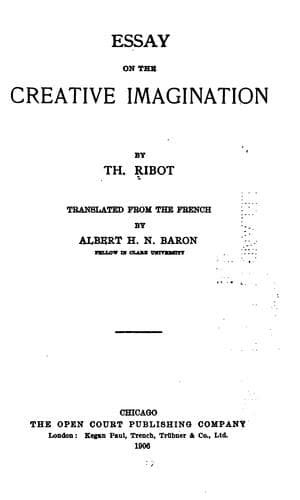
Essay on the Creative ImaginationRibot, Th. (Théodule)
Science
Essay on the Creative Imagination
Ribot, Th. (Théodule)
Creation (Literary, artistic, etc.); Imagination
The combining imagination joined to the inductive spirit constitutes
"the talent for invention strictly so-called," in industry, in the
technique of science; it gives the artist and the poet the power of
composing their works.
The combining imagination plus the deductive spirit gives the
speculative talent of the mathematician and philosopher; deduction
predominates in the former, imagination in the latter.[78]
FOOTNOTES:
[78] Wundt, _Physiologische Psychologie_, 4th German edition, Vol.
II, pp. 490-95.
CHAPTER I
THE PLASTIC IMAGINATION
I
By "plastic imagination" I understand that which has for its special
characters clearness and precision of form; more explicitly those forms
whose materials are clear images (whatever be their nature), approaching
perception, giving the impression of reality; in which, too, there
predominate _associations with objective relations_, determinable with
precision. The plastic mark, therefore, is in the images, and in the
modes of association of images. In somewhat rough terms, requiring
modifications which the reader himself can make, it is the imagination
that materializes.
Between perception--a very complex synthesis of qualities, attributes
and relations--and conception--which is only the consciousness of a
quality, quantity, or relation, often of only a single word accompanied
by vague outlines and a latent, potential knowledge; between concrete
and abstract, the image occupies an intermediate position and can run
from one pole to another, now full of reality, now almost as poor and
pale as a concept. The representation here styled plastic descends
towards its point of origin; it is an external imagination, arising from
sensation rather than from feeling and needing to become objective.
Thus its general characters are easy of determination. First and
foremost, it makes use of visual images; then of motor images; lastly,
in practical invention, of tactile images. In a word, the three groups
of images present to a great extent the character of externality and
objectivity. The clearness of form of these three groups proceeds from
their origin, because they arise from sensation well determined in
space--sight, movement, touch. Plastic imagination depends most on
spatial conditions. We shall see that its opposite, diffluent
imagination, is that which depends least upon that factor, or is most
free from it. Among these naturally objective elements the plastic
imagination chooses the most objective, which fact gives its creations
an air of reality and life.
The second characteristic is inferiority of the affective element; it
appears only intermittently and is entirely blotted out before sensory
impression. This form of the creative imagination, coming especially
from sensation, aims especially at sensation. Thus it is rather
superficial, greatly devoid of that internal mark that comes from
feeling.
Public-domain text, read in full here on John Shaqi.
Reviews
Reviews
No reviews yet
Be the first to share your thoughts on this work.
Elsewhere in the archive
Join the Discussion
Join the discussion
Sign in to leave a comment or review.
Sign InorCreate an account