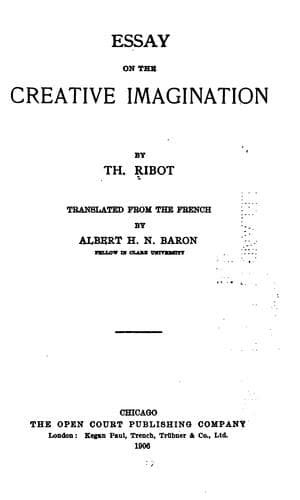
Essay on the Creative ImaginationRibot, Th. (Théodule)
Science
Essay on the Creative Imagination
Ribot, Th. (Théodule)
Creation (Literary, artistic, etc.); Imagination
In literature this altogether foreign mode of creative activity has
found its most complete expression among the _Parnassiens_ and their
congeners, whose creed is summed up in the formula, faultless form and
impassiveness. Theophile Gautier claims that "a poet, no matter what may
be said of him, is a _workman_; it is not necessary that he have more
intelligence than a laborer and have knowledge of a state other than his
own, without which he does badly. I regard as perfectly absurd the mania
that people have of hoisting them (the poets) up onto an ideal pedestal;
_nothing is less ideal than a poet_. For him words have in themselves
and outside the meaning they express, their own beauty and value, just
like precious stones not yet cut and mounted in bracelets, necklaces and
rings; they charm the understanding that looks at them and takes them
from the finger to the little pile where they are put aside for future
use." If this statement, whether sincere or not, is taken literally, I
see no longer any difference, save as regards the materials employed,
between the imagination of poets and the imagination active in the
mechanical arts. For the usefulness of the one and the "uselessness" of
the other is a characteristic foreign to invention itself.
3. In the teeming mass of myths and religious conceptions that the
nineteenth century has gathered with so much care we could establish
various classifications--according to race, content, intellectual level;
and, in a more artificial manner but one suitable for our subject,
according to the degree of precision or fluidity.
Neglecting intermediate forms, we may, indeed, divide them into two
groups; some are clear in outline, are consistent, relatively logical,
resembling a definite historical relation; others are vague, multiform,
incoherent, contradictory; their characters change into one another, the
tales are mixed and are imperceptible in the whole.
The former types are the work of the plastic imagination. Such are, if
we eliminate oriental influences, most of the myths belonging to Greece
when, on emerging from the earliest period, they attained their definite
constitution. It has been held that the plastic character of these
religious conceptions is an effect of esthetic development: statues,
bas-reliefs, poetry, and even painting, have made definite the
attributes of the gods and their history. Without denying this influence
we must nevertheless understand that it is only auxiliary. To those who
would challenge this opinion let us recall that the Hindoos have had
gigantic poems, have covered their temples with numberless sculptures,
and yet their fluid mythology is the opposite of the Greek. Among the
peoples who have incarnated their divinities in no statue, in no human
or animal form, we find the Germans and the Celts. But the mythology of
the former is clear, well kept within large lines; that of the latter is
fleeting and inconsistent--the despair of scholars.[84]
Public-domain text, read in full here on John Shaqi.
Reviews
Reviews
No reviews yet
Be the first to share your thoughts on this work.
Elsewhere in the archive
Join the Discussion
Join the discussion
Sign in to leave a comment or review.
Sign InorCreate an account