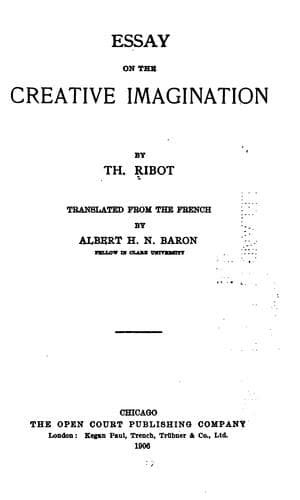
Essay on the Creative ImaginationRibot, Th. (Théodule)
Science
Essay on the Creative Imagination
Ribot, Th. (Théodule)
Creation (Literary, artistic, etc.); Imagination
Its psychological constitution is reducible to two elements: slightly
concrete images, _schemas_ approaching general ideas; for their
association, relations predominantly rational, more the products of the
logic of the intellect than of the logic of the feelings. It lacks the
sudden, violent shock of emotion that gives brilliancy to images, making
them arise and grouping them in unforeseen combinations. It is a form of
invention and construction that is more the work of reason than of
imagination proper.
Consequently, is it not paradoxical to relate it to plastic imagination,
as species to genus? It would be idle to enter upon a discussion of the
subject here without attempting a classification; let us merely note the
likenesses and differences. Both are above all objective--the first,
because it is sensory; the other, because it is rational. Both make use
of analogous modes of association, dependent more on the nature of
things than on the personal impression of the subject. Opposition exists
only on one point: the former is made up of vivid images that approach
perception; the latter is made up of internal images bordering upon
concepts. Rational imagination is plastic imagination desiccated and
simplified.
FOOTNOTES:
[79] Thus Taine says of Carlyle: "He cannot stick to simple
expression; at every step he drops into figures, gives body to every
idea, must touch forms. We see that he is possessed and haunted by
glittering or saddening visions; in him every thought is an
explosion; a flood of seething passion reaches the boiling-point in
his brain, which overflows, and the torrent of images runs over the
banks and rushes with all its mud and all its splendor. He cannot
reason, he must paint." Despite the vigor of this sketch, the
perusal of ten pages of _Sartor Resartus_ or of the _French
Revolution_ teaches more in regard to the nature of this imagination
than all the commentaries.
[80] For a point of view in criticism that has seemed correct to
many on this matter, compare the well-known chapter on the "Pathetic
Fallacy" by Ruskin, in his _Modern Painters_. (Tr.)
[81] Arreat (_Psychologie du peintre_, pp. 62 ff.) gives a large
number of examples of this.
[82] _Ibid._, p. 115.
[83] For further details on this point, consult Mabilleau, _Victor
Hugo_, 2nd part, chaps. II, III, IV.--Renouvier, in the book devoted
to the poet, asserts that "on account of his aptitude for
representing to himself the details of a figure, order and position
in space, beyond any present sensation," Victor Hugo could have
become a mathematician of the highest order.
[84] As bearing out the position of the author, we may also call
attention to the fact that while the Hebrew race has had very slight
development in the plastic arts, yet its mythology has always taken
a very definite form, even when dealing with the vaguest and most
abstract subjects. (Tr.)
[85] Fouillee, _Psychologie du peuple francais_, p. 185.
CHAPTER II
THE DIFFLUENT IMAGINATION
I
Public-domain text, read in full here on John Shaqi.
Reviews
Reviews
No reviews yet
Be the first to share your thoughts on this work.
Elsewhere in the archive
Join the Discussion
Join the discussion
Sign in to leave a comment or review.
Sign InorCreate an account