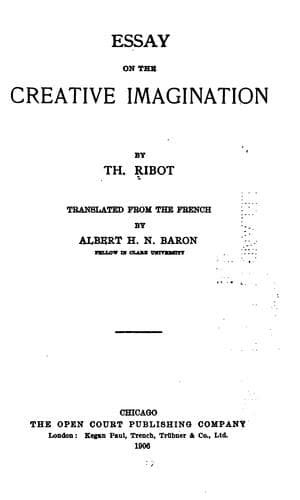
Essay on the Creative ImaginationRibot, Th. (Théodule)
Science
Essay on the Creative Imagination
Ribot, Th. (Théodule)
Creation (Literary, artistic, etc.); Imagination
Depending on linguistics, it has recently been maintained that, among
the Aryans at least, the imagination created at first only momentary
gods (_Augenblicksgoetter_).[88] Every time that primitive man, in the
presence of a phenomenon, experienced a perceptible emotion, he
translated it by a name, the manifestation of what was imagined the
divine part in the emotion felt. "Every religious emotion gives rise to
a new name--i.e., a new divinity. But the religious imagination is
never identical with itself; though produced by the same phenomenon, it
translates itself, at two different moments, by two different words." As
a consequence, "during the early periods of the human race, religious
names must have been applied not to _classes_ of beings or events but to
_individual_ beings or events. Before worshipping the comet or the
fig-tree, men must have worshiped each one of the comets they beheld
crossing the sky, every one of the fig-trees that their eyes saw."
Later, with advancing capacity for generalization, these "instantaneous"
divinities would be condensed into more consistent gods. If this
hypothesis, which has aroused many criticisms, be sound--if this state
were met with--it would be the ideal type of imaginative instability in
the religious order.
Nearer to us, authentic evidence shows that certain peoples, at given
stages of their history, have created such vague, fluid myths, that we
cannot succeed in delimiting them. Every god can change himself into
another, different, or even opposite, one. The Semitic religions might
furnish examples of this. There has been established the identity of
Istar, Astarte, Tanit, Baalath, Derketo, Mylitta, Aschera, and still
others. But it is in the early religion of the Hindoos that we perceive
best this kaleidoscopic process applied to divine beings. In the vedic
hymns not only are the clouds now serpents, now cows and later
fortresses (the retreats of dark Asuras), but we see Agni (fire)
becoming Kama (desire or love), and Indra becoming Varuna, and so on.
"We cannot imagine," says Taine, "such a great clearness. The myth here
is not a disguise, but an expression; no language is more true and more
supple. It permits a glimpse of, or rather, it causes us to discern the
forms of clouds, movements of the air, changes of seasons, all the
happenings of sky, fire, storm: external nature has never met a mind so
impressionable and pliant in which to mirror itself in all the
inexhaustible variety of its appearances. However changeable nature may
be, this imagination corresponds to it. It has no fixed gods; they are
changeable like the things themselves; they blend one into another.
Everyone of them is in turn the supreme deity; no one of them is a
distinct personality; everyone is only a moment of nature, able,
according to the apperception of the moment, to include its neighbor or
be included by it. In this fashion they swarm and teem. Every moment of
Public-domain text, read in full here on John Shaqi.
Reviews
Reviews
No reviews yet
Be the first to share your thoughts on this work.
Elsewhere in the archive
Join the Discussion
Join the discussion
Sign in to leave a comment or review.
Sign InorCreate an account