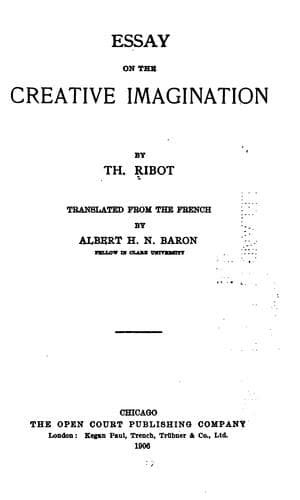
Essay on the Creative ImaginationRibot, Th. (Théodule)
Science
Essay on the Creative Imagination
Ribot, Th. (Théodule)
Creation (Literary, artistic, etc.); Imagination
A principal process consists of employing usual words and changing their
ordinary acceptation, or rather, associating them in such a way that
they lose their precise meaning, and appear vague and mysterious: these
are the words "written in the depths." The writers do not name--they
leave it for us to infer. "They banish commonplaces through lack of
precision, and leave to things only the power of moving." A rose is not
described by the particular sensations that it causes, but by the
general condition that it excites.
Another method is the employment of new words or words that have fallen
into disuse. Ordinary words retain, in spite of everything, somewhat of
their customary meaning, associations and thoughts condensed in them
through long habit; words forgotten during four or five centuries
escape this condition--they are coins without fixed value.
Lastly, a still more radical method is the attempt to give to words an
exclusively emotional valuation. Unconsciously or as the result of
reflection some symbolists have come to this extreme trial, which the
logic of events imposed upon them. Ordinarily, thought expresses itself
in words; feeling, in gestures, cries, interjections, change of tone: it
finds its complete and classic expression in music. The symbolists want
to transfer the role of sound to words, to make of them the instrument
for translating and suggesting emotion through sound alone: words have
to act not as signs but as sounds: they are "musical notes in the
service of an impassioned psychology."
All this, indeed, concerns only imagination expressing itself in words;
but we know that the symbolic school has applied itself to the plastic
arts, to treat them in its own way. The difference, however, is in the
vesture that the esthetic ideal assumes. The pre-Raphaelites have
attempted, by effacing forms, outlines, semblances, colors, "to cause
things to appear as mere sources of emotion," in a word, to _paint_
emotions.
To sum up--In this form of the diffluent imagination the emotional
factor exercises supreme authority.
May the type of imagination, the chief manifestations of which we have
just enumerated, be considered as identical with the idealistic
imagination? This question is similar to that asked in the preceding
chapter, and permits the same answer. In idealistic art, doubtless, the
material element furnished in perception (form, color, touch, effort) is
minimized, subtilized, sublimated, refined, so as to approach as nearly
as possible to a purely internal state. By the nature of its favorite
images, by its preference for vague associations and uncertain
relations, it presents all the characteristics of diffluent imagination;
but the latter covers a much broader field: it is the genus of which the
other is a species. Thus, it would be erroneous to regard the fantastic
imagination as idealistic; it has no claim to the term: on the contrary,
it believes itself adapted for practical work and acts in that
direction.
Public-domain text, read in full here on John Shaqi.
Reviews
Reviews
No reviews yet
Be the first to share your thoughts on this work.
Elsewhere in the archive
Join the Discussion
Join the discussion
Sign in to leave a comment or review.
Sign InorCreate an account