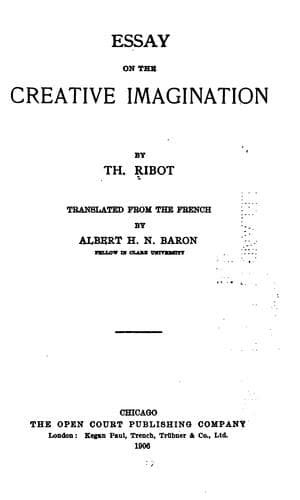
Essay on the Creative ImaginationRibot, Th. (Théodule)
Science
Essay on the Creative Imagination
Ribot, Th. (Théodule)
Creation (Literary, artistic, etc.); Imagination
The passage from the imaginative to the rational phase may be slow or
sudden. "For eight months," says Kepler, "I have seen a first glimmer;
for three months, daylight; for the last week I see the sunlight of the
most wonderful contemplation." On the other hand, Hauey drops a bit of
crystallized calcium spar, and, looking at one of the broken prisms,
cries out, "All is found!" and immediately verifies his quick intuition
in regard to the true nature of crystallization. We have already
indicated[114] the psychological reasons for these differences.
Underneath all the reasoning, inductions, deductions, calculations,
demonstrations, methods, and logical apparatus of every sort, there is
something animating them that is not understood, that is the work of
that complex operation--the constructive imagination.
To conclude: The hypothesis is a creation of the mind, invested with a
provisional reality that may, after verification, become permanent.
False hypotheses are characterized as imaginary, by which designation is
meant that they have not become freed from the first state. But for
psychology they are different neither in their origin nor in their
nature from those scientific hypotheses that, subjected to the power of
reason or of experiment, have come out victorious. Besides, in addition
to abortive hypotheses, there are dethroned ones. What theory was more
clinging, more fascinating in its applications, than that of phlogiston?
Kant[115] praised it as one of the greatest discoveries of the
eighteenth century. The development of the sciences is replete with
these downfalls. They are psychological regressions: the invention,
considered for a time as adequate to reality, decays, returns to the
imaginative phase whence it seems to have emerged, and remains pure
imagination.
IV
Imagination is not absent from the third stage of scientific research,
in demonstration and experimentation, but here we must be brief, (1)
because it passes to a minor place, yielding its rank to other modes of
investigation, and (2) because this study would have to become doubly
employed with the practical and mechanical imagination, which will
occupy our attention later. The imagination is here only an auxiliary, a
useful instrument, serving:
(1) In the sciences of reasoning, to discover ingenious methods of
demonstration, stratagems for avoiding or overcoming difficulties.
(2) In the experimental sciences for inventing methods of research or of
control--whence its analogy, above mentioned, to the practical
imagination. Furthermore, the reciprocal influence of these two forms of
imagination is a matter of common observation: a scientific discovery
permits the invention of new instruments; the invention of new
instruments makes possible experiments that are increasingly more
complicated and delicate.
Public-domain text, read in full here on John Shaqi.
Reviews
Reviews
No reviews yet
Be the first to share your thoughts on this work.
Elsewhere in the archive
Join the Discussion
Join the discussion
Sign in to leave a comment or review.
Sign InorCreate an account