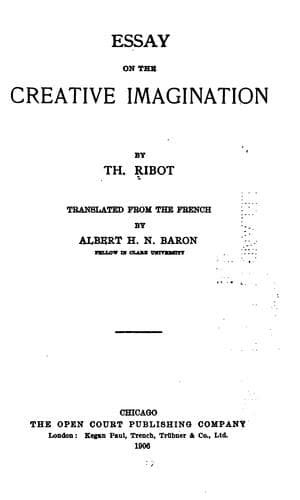
Essay on the Creative ImaginationRibot, Th. (Théodule)
Science
Essay on the Creative Imagination
Ribot, Th. (Théodule)
Creation (Literary, artistic, etc.); Imagination
In closing, let us note that financial imagination does not always have
as its goal the enriching of an individual or of a closely limited group
of associates: it can aim higher, act on greater masses, address itself
strenuously to a problem as complex as the reformation of the finances
of a powerful state. All the civilized nations count in their history
men who imagined a financial system and succeeded, with various
fortunes, in making it prevail. The word "system," consecrated by usage,
makes unnecessary any comment, and relates this form of imagination to
that of scientists and philosophers. Every system rests on a
master-conception, on an ideal, a center about which there is assembled
the mental construction made up of imagination and calculation which, if
circumstances permit, must take shape, must show that it can live.
Let us call to mind the author of the first, or at least, of the most
notorious of these "systems." Law claimed that he was applying "the
methods of philosophy, the principles of Descartes, to social economy,
abandoned hitherto to chance and empiricism." His ideal was the
institution of _credit_ by the state. Commerce, said he, was during its
first stage the exchange of merchandise in kind; in a second stage,
exchange by means of another, more manageable, commodity or universal
value, security equivalent to the object it represented; it must enter
a third stage when exchange will be made by a purely conventional sign
having no value of its own. Paper represents money, just as the latter
represents goods, "with the difference that the paper is not security,
but a simple promise, constituting credit." The state must do
systematically what individuals have done instinctively; but it must
also do what individuals cannot do--create currency by printing on the
paper of exchange the seal of public authority. We know the history of
the downfall of this system, the eulogies and criticisms it has
received:--but because of the originality and boldness of his views, the
inexhaustible fecundity of his lesser inventions, Law holds an
undisputed place among the great imaginative minds.
III
We said above that commerce, in its higher manifestations, is a kind of
war.[135] Here, then, would be the place to study the military
imagination. The subject cannot be treated save by a man of the
profession, so I shall limit myself to a few brief remarks based on
personal information, or gleaned from authorities.
Public-domain text, read in full here on John Shaqi.
Reviews
Reviews
No reviews yet
Be the first to share your thoughts on this work.
Elsewhere in the archive
Join the Discussion
Join the discussion
Sign in to leave a comment or review.
Sign InorCreate an account