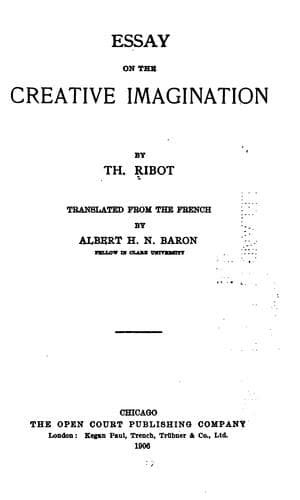
Essay on the Creative ImaginationRibot, Th. (Théodule)
Science
Essay on the Creative Imagination
Ribot, Th. (Théodule)
Creation (Literary, artistic, etc.); Imagination
Thus, from the viewpoint of our present study, we may divide ethics into
living and dead. Living ethics arise from needs and desires, stimulate
an imaginative construction that becomes fixed in actions, habits and
laws; they offer to men a concrete, positive ideal which, under various
and often contrary aspects, is always happiness. The lifeless ethics,
from which invention has withdrawn, arise from reflection upon, and the
rational codification of, living ethics. Stored away in the writings of
philosophers, they remain theoretical, speculative, without appreciable
influence on the masses, mere material for dissertation and commentary.
In proportion as we recede from distant origins the light grows, and
invention in the social and moral order becomes manifest as the work of
two principal categories of minds--the fantastic, the positive. The
former, purely imaginative beings, visionaries, utopians, are closely
related to poets and artists. The latter, practical creators or
reformers, capable of organizing, belong to the family of inventors in
the industrial-commercial-mechanical order.
I
The chimerical form of imagination, applied to the social sciences, is
the one that, taking account neither of the external determinism nor of
practical requirements, spreads out freely. Such are the creators of
ideal republics, seeking for a lost or to-be-discovered-in-the-future
golden age, constructing, as their fancy pleases, human societies in
their large outlines and in their details. They are social novelists,
who bear the same relation to sociologists that poets do to critics.
Their dreams, subjected merely to the conditions of an inner logic, have
lived only within themselves, an ideal life, without ever passing
through the test of application. It is the creative imagination in its
unconscious form, restrained to its first phase.
Nothing is better known than their names and their works: The _Republic_
of Plato, Thomas More's _Utopia_, Campanella's _City of the Sun_,
Harrington's _Oceana_, Fenelon's _Salente_, etc.[141] However idealistic
they may be, one could easily show that all the materials of their ideal
are taken from the surrounding reality, they bear the stamp of the
_milieu_, be it Greek, English, Christian, etc., in which they lived,
and it should not be forgotten that in the Utopians everything is not
chimerical--some have been revealers, others have acted as stimuli or
ferments. True to its mission, which is to make innovations, the
constructive imagination is a spur that arouses; it hinders social
routine and prevents stagnation.
Public-domain text, read in full here on John Shaqi.
Reviews
Reviews
No reviews yet
Be the first to share your thoughts on this work.
Elsewhere in the archive
Join the Discussion
Join the discussion
Sign in to leave a comment or review.
Sign InorCreate an account