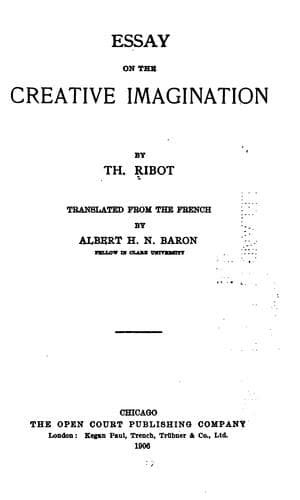
Essay on the Creative ImaginationRibot, Th. (Théodule)
Science
Essay on the Creative Imagination
Ribot, Th. (Théodule)
Creation (Literary, artistic, etc.); Imagination
[68] For an elaborate and interesting discussion of this subject,
see Tolstoi's _Physiology of War_. As showing the later trend of
thought on this general theme, see the excellent summary by
Professor Seligman, _The Economic Interpretation of History_. (Tr.)
[69] William James, _The Will to Believe and other Essays_, pp. 218
ff.; Jastrow, _Psych. Rev._, May, 1898, p. 307; J. Royce, _ibid._,
March, 1898; Baldwin, _Social and Ethical Interpretations_, etc.
[70] Joly, _Psychologie des grands hommes_.
[71] Osborn, _From the Greeks to Darwin_.
[72] Such, according to Binet and Passy, seem to be the cases of the
Goncourts, Pailleron, etc. See "Psychologie des auteurs
dramatiques," in _L'annee psychologique_, I, 96.
[73] Compare the striking instance of this moment as given by
Froebel, in his _Autobiography_, in connection with his idea of the
Kindergarten. (Tr.)
[74] Quoted by Arreat, _Memoire et Imagination_, p. 118. (Paris, F.
Alcan.)
[75] Paulhan ("De l'invention," _Rev. Philos._, December, 1898, pp.
590 ff.) distinguishes three kinds of development in invention: (1)
Spontaneous or reasoned--the directing idea persists to the end; (2)
transformation, which comprises several contradictory evolutions
succeeding and replacing one another in consequence of impressions
and feelings; (3) deviation, which is a composite of the two
preceding forms.
[76] Cf. the well-known doctrine of Empedocles. (Tr.)
[77] P. Souriau, _Theorie de l'invention_, pp. 6-7.
CHAPTER V
LAW OF THE DEVELOPMENT OF THE IMAGINATION
Is imagination, so often called "a capricious faculty," subject to some
law? The question thus asked is too simple, and we must make it more
precise.
As the direct cause of invention, great or small, the imagination acts
without assignable determination; in this sense it is what is known as
"spontaneity"--a vague term, which we have attempted to make clear. Its
appearance is irreducible to any law; it results from the often
fortuitous convergence of various factors previously studied.
Leaving aside the moment of origin, does the inventive power, considered
in its individual and specific development, seem to follow any law, or,
if this term appear too ambitious, does it present, in the course of its
evolution, any perceptible regularity? Observation separates out an
empirical law; that is, extracts directly an abridged formula that is
only a condensation of facts. We may enunciate it thus: The creative
imagination in its complete development passes through two periods
separated by a critical phase: a period of autonomy or efflorescence, a
critical moment, a period of definitive constitution presenting several
aspects.
Public-domain text, read in full here on John Shaqi.
Reviews
Reviews
No reviews yet
Be the first to share your thoughts on this work.
Elsewhere in the archive
Join the Discussion
Join the discussion
Sign in to leave a comment or review.
Sign InorCreate an account