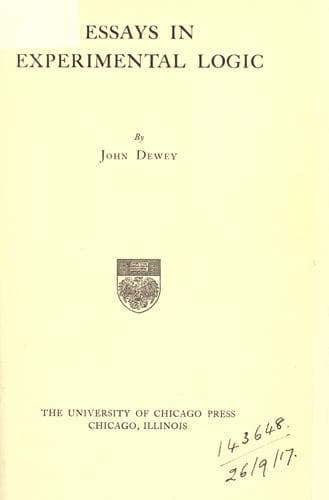
Of the two parts of this paper the first is a study in formal analysis.
It attempts to show that there is no problem, logically speaking, of
the existence of an external world. Its point is to show that the very
attempt to state the problem involves a self-contradiction: that the
terms cannot be stated so as to generate a problem without assuming
what is professedly brought into question. The second part is a summary
endeavor to state the actual question which has given rise to the
unreal problem and the conditions which have led to its being
misconstrued. So far as subject-matter is concerned, it supplements the
first part; but the argument of the first part in no way depends upon
anything said in the second. The latter may be false and its falsity
have no implications for the first.
I
There are many ways of stating the problem of the existence of an
external world. I shall make that of Mr. Bertrand Russell the basis of
my examinations, as it is set forth in his recent book _Our Knowledge
of the External World as a Field for Scientific Method in Philosophy_.
I do this both because his statement is one recently made in a book
of commanding importance, and because it seems to me to be a more
careful statement than most of those in vogue. If my point can be made
out for his statement, it will apply, a fortiori, to other statements.
Even if there be those to whom this does not seem to be the case, it
will be admitted that my analysis must begin somewhere. I cannot take
the space to repeat the analysis in application to differing modes of
statement with a view to showing that the method employed will yield
like results in all cases. But I take the liberty of throwing the
burden upon the reader and asking him to show cause why it does not so
apply.
After rejecting certain familiar formulations of the question because
they employ the not easily definable notions of the self and
independence, Mr. Russell makes the following formulation: Can we
"know that objects of sense ... exist at times when we are not
perceiving them?" (_op. cit._, p. 75). Or, in another mode of
statement: "Can the existence of anything other than our own[63] hard
data be inferred from the existence of those data?" (pp. 73 and 83).
Public-domain text, read in full here on John Shaqi.
Reviews
Reviews
No reviews yet
Be the first to share your thoughts on this work.
Elsewhere in the archive
Join the Discussion
Join the discussion
Sign in to leave a comment or review.
Sign InorCreate an account