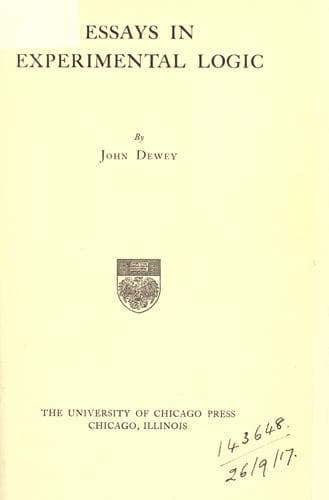
In the logical version of pragmatism termed instrumentalism, action or
practice does indeed play a fundamental rôle. But it concerns not the
nature of consequences but the nature of knowing. To use a term which
is now more fashionable (and surely to some extent in consequence of
pragmatism) than it was earlier, instrumentalism means a behaviorist
theory of thinking and knowing. It means that knowing is literally
something which we do; that analysis is ultimately physical and
active; that meanings in their logical quality are standpoints,
attitudes, and methods of behaving toward facts, and that active
experimentation is essential to verification. Put in another way it
holds that thinking does not mean any transcendent states or acts
suddenly introduced into a previously natural scene, but that the
operations of knowing are (or are artfully derived from) natural
responses of the organism, which constitute knowing in virtue of the
situation of doubt in which they arise and in virtue of the uses of
inquiry, reconstruction, and control to which they are put. There is
no warrant in the doctrine for carrying over _this_ practical quality
into the consequences in which action culminates, and by which it is
tested and corrected. A knowing as an act is instrumental to the
resultant controlled and more significant situation; this does not
imply anything about the intrinsic or the instrumental character of
the consequent situation. That is whatever it may be in a given case.
There is nothing novel nor heterodox in the notion that thinking is
instrumental. The very word is redolent of an _Organum_--whether
_novum_ or _veterum_. The term "instrumentality," applied to thinking,
raises at once, however, the question of whether thinking as a tool
falls within or without the subject-matter which it shapes into
knowledge. The answer of formal logic (adopted moreover by Kant and
followed in some way by all neo-Kantian logics) is unambiguous. To
call logic "formal" means precisely that mind or thought supplies
forms foreign to the original subject-matter, but yet required in
order that it should have the appropriate form of knowledge. In this
regard it deviates from the Aristotelian _Organon_ which it professes
to follow. For according to Aristotle, the processes of knowing--of
teaching and learning--which lead up to knowledge are but the
actualization through the potentialities of the human body of the
_same_ forms or natures which are previously actualized in Nature
through the potentialities of extra-organic bodies. Thinking which is
not instrumental to truth, which is merely formal in the modern sense,
would have been a monstrosity inconceivable to him. But the discarding
of the metaphysics of form and matter, of cyclic actualizations and
eternal species, deprived the Aristotelian "thought" of any place
within the scheme of things, and left it an activity with forms alien
to subject-matter. To conceive of thinking as instrumental to truth or
Public-domain text, read in full here on John Shaqi.
Reviews
Reviews
No reviews yet
Be the first to share your thoughts on this work.
Elsewhere in the archive
Join the Discussion
Join the discussion
Sign in to leave a comment or review.
Sign InorCreate an account