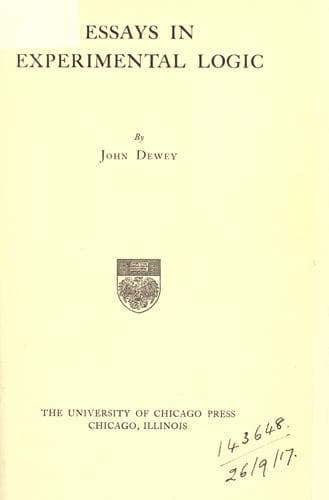
As against all this, the present paper takes its stand with the
position stated by Hume, in the following words: "A passion is an
original existence, or, if you will, modification of existence; and
contains not any representative quality, which renders it a copy of
any other existence or modification. When I am angry I am actually
possest with the passion, and in that emotion have no more a reference
to any other object, than when I am thirsty, or sick, or more than
five feet high."[84] In so doing, I may seem to some to be begging the
question at issue. But such is surely the prima facie fact of the
matter. Only a prior dogma to the effect that every conscious
experience _is_, _ipso facto_, a form of cognition leads to any
obscuration of the fact, and the burden of proof is upon those who
uphold the dogma.[85]
A further word upon "appreciation" seems specially called for in view
of the currency of the doctrine that "appreciation" is a peculiar kind
of knowledge, or cognitive revelation of reality: peculiar in having a
distinct type of reality for its object and in having for its organ a
peculiar mental condition differing from the intelligence of everyday
knowledge and of science. Actually, there do not seem to be any
grounds for regarding appreciation as anything but an intentionally
enhanced or intensified experience of an object. Its opposite is not
descriptive or explanatory knowledge, but _de_preciation--a degraded
realization of an object. A man may climb a mountain to get a better
realization of a landscape; he may travel to Greece to get a
realization of the Parthenon more full than that which he has had from
pictures. Intelligence, knowledge, may be involved in the steps taken
to get the enhanced experience, but that does not make the landscape
or the Parthenon as fully savored a cognitive object. So the fulness
of a musical experience may depend upon prior critical analysis, but
that does not necessarily make the hearing of music a kind of
non-analytic cognitive act. Either appreciation means just an
intensified experience, or it means a kind of criticism, and then it
falls within the sphere of ordinary judgment, differing in being
applied to a work of art instead of to some other subject-matter. The
same mode of analysis may be applied to the older but cognate term
"intuition." The terms "acquaintance" and "familiarity" and
"recognition" (acknowledgment) are full of like pitfalls of ambiguity.
Public-domain text, read in full here on John Shaqi.
Reviews
Reviews
No reviews yet
Be the first to share your thoughts on this work.
Elsewhere in the archive
Join the Discussion
Join the discussion
Sign in to leave a comment or review.
Sign InorCreate an account