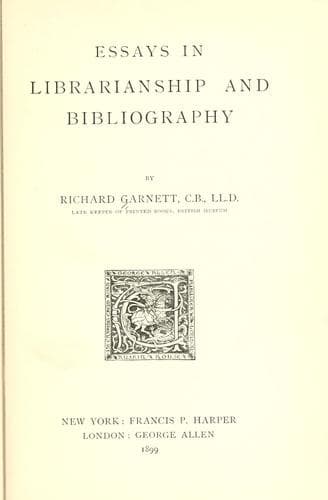
Essays in Librarianship and BibliographyGarnett, Richard
Science
Essays in Librarianship and Bibliography
Garnett, Richard
Bibliography -- Methodology; British Museum; Library science
It would be interesting to
learn what became of the books and the pension; if the facts are not
already upon record they ought to be investigated. From the preface to a
posthumous work of Canevarius, published by his brother, it would almost
seem that the family had some control over it, and if so they may have
dilapidated it. If the library, when transmitted to Genoa, contained all
the elaborate bindings which are now esteemed so precious, it was a
bequest of more value than could have been supposed at the time. Though
stingy and covetous in his life, Canevarius was a benefactor to many at
his death. He left, Nicius says, such a multitude of legacies, and such
a host of minute directions to be observed after his decease, that his
will was as big as a book. The ruling passion of parsimony remained with
him, and he gave a remarkable instance of it in his last illness.
"When," says Nicius, "ten days before his death, an old woman who had
come to nurse him gave him an egg to suck, and then took a new napkin
from a cupboard to wipe his lips; 'What mean you,' cried he, 'by
spoiling a new napkin? was there never a tattered one in the house?
Depart to the infernal regions!'" Yet even here Canevarius emerges
victorious, for the disparaging biographer is constrained to admit that
he _had_ a new napkin.
The next chapter of bibliographical anecdote which I propose to cite
from Nicius Erythræus is not derived from his Pinacotheca, but from his
Epistles. It relates to persons of more importance than Demetrius
Canevarius, to no less a man, indeed, than Cardinal Mazarin, and to the
eminent French scholar Gabriel Naudé, then (1645) employed as his agent
in collecting the first Mazarin Library, so unhappily destroyed and
dispersed a few years afterwards by the hostile Parliament of Paris.
Naudé has deplored the fate of the collection in a book devoted to it,
and Nicius, his intimate friend and correspondent, powerfully confirms
the loss which letters thus received by his description of Naudé's
exertions as a collector, in a letter he writes to Cardinal Chigi, Papal
nuncio in Germany. After mentioning that Naudé had seventeen years
before obtained great credit by a work "On the Formation of Public
Libraries," and that Mazarin having laid the foundation of his library
by buying that of a Canon of Limoges, consisting of six thousand
volumes, Naudé had doubled this number by purchases within one year; he
adds, "Finding nothing more to buy in Paris he went to Belgium, and
there took the pick of the market; and this year has come to Italy,
where the booksellers' shops seem devastated as by a whirlwind. He buys
up everything, printed or manuscript, in all languages, leaves the
shelves empty behind him, and sometimes comes down upon them with a
rule, and insists upon taking their contents by the yard. Often, seeing
masses of books accumulated together, he asks the price of the entire
lot; it is named; differences ensue; but, by dint of urging, bullying,
Public-domain text, read in full here on John Shaqi.
Reviews
Reviews
No reviews yet
Be the first to share your thoughts on this work.
Elsewhere in the archive
Join the Discussion
Join the discussion
Sign in to leave a comment or review.
Sign InorCreate an account