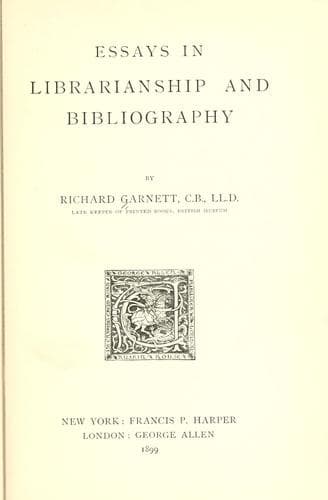
Essays in Librarianship and BibliographyGarnett, Richard
Science
Essays in Librarianship and Bibliography
Garnett, Richard
Bibliography -- Methodology; British Museum; Library science
Further instructions follow respecting the control to be exercised over
the librarian, who is to give an account of his stewardship once a year
to the doctors of the university, who are themselves, each in his own
faculty, to suggest additional books proper to be added to the library.
Dury seems to have no doubt that funds will always be forthcoming, as
well as for the librarian's "extraordinary expenses in correspondencies
and transcriptions for the public good." It seems to be expected that he
will frequently make advances out of his own pocket. Dury glides lightly
over these ticklish financial details, which, however, remind him of the
existence of a law of copyright, and the probable accumulation of
accessions undesirable from the point of view of mere scholarship. His
observations on this point are full of liberality and good sense:—
"I understand that all the book-printers or stationers of the
Commonwealth are bound of every book that is printed, to send a copy
into the University Library; and it is impossible for one man to read
all the books in all faculties, to judge of them what worth there is in
them; nor hath every one ability to judge of all kind of sciences what
every author doth handle, and how sufficiently; therefore I would have
at this time of giving accounts, the library keeper also bound to
produce the catalogue of all the books sent unto the University's
library by the stationers that printed them; to the end that every one
of the doctors in their own faculties should declare whether or no they
should be added, and where they should be placed in the catalogue of
additionals. For I do not think that all books and treatises, which in
this age are printed in all kinds, should be inserted into the
catalogue, and added to the stock of the library; discretion must be
used and confusion avoided, and a course taken to distinguish that
which is profitable from that which is useless; and according to the
verdict of that society, the usefulness of books for the public is to be
determined. Yet because there is seldom any books wherein there is not
something useful, and books freely given are not to be cast away, but
may be kept, therefore I would have a peculiar place appointed for such
books as shall be laid aside to keep them in, and a catalogue of their
titles made alphabetically in reference to the author's name and a note
of distinction to show the science to which they are to be referred." It
seems then, that if Dury could have advised Bodley, and Bodley had
listened to him, the Bodleian would have been rich in early
Shakespeares, and might have preserved many publications now entirely
lost.
Dury's second letter on the subject merely repeats the ideas of the
first with less practical suggestion and in a more declamatory style. It
contains a striking passage on the ruin of the library of Heidelberg, a
terrible warning to librarians. It had books, it had manuscripts, but it
had no catalogue, and its candlestick was taken away.
Public-domain text, read in full here on John Shaqi.
Reviews
Reviews
No reviews yet
Be the first to share your thoughts on this work.
Elsewhere in the archive
Join the Discussion
Join the discussion
Sign in to leave a comment or review.
Sign InorCreate an account