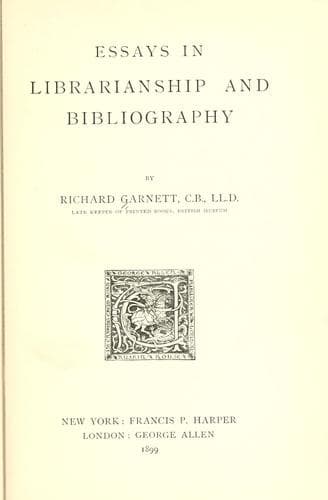
Essays in Librarianship and BibliographyGarnett, Richard
Science
Essays in Librarianship and Bibliography
Garnett, Richard
Bibliography -- Methodology; British Museum; Library science
It will have been observed that Dury's suggestions have reference solely
to university libraries. The conception of a really popular library did
not then exist, and it may be doubted whether in any case even one so
much in advance of his time could have reconciled himself to the idea of
a collection where every description of literature, embodying every
variety of opinion, should be indiscriminately accessible to every
condition of men. But this very limitation of his views should render
his admonition, and his lofty standard of the librarian's duty, more
interesting and significant to the librarians of the nineteenth century.
For if the advising function was rightly deemed so important in him who
had to consult with university professors, men probably of more learning
than himself, much more is its judicious exercise required in him who
has to aid the researches and direct the studies of the comparatively
ignorant. "The Reformed Library Keeper," therefore, has a message for
our age as well as its own; and we need not regret the half-hour we have
spent with good old John Dury, the first who discovered that a librarian
had a soul to be saved.
FOOTNOTES:
[174:1] Read at the Monthly Meeting of the Library Association, March
1884.
[188:1] See Wilken, "Geschichte der Bildung, Beraubung, und Vernichtung
der alten Heidelbergischen Büchersammlungen" (Heidelberg, 1817).
THE MANUFACTURE OF FINE PAPER IN ENGLAND IN THE EIGHTEENTH CENTURY
The MS. correspondence of Conyers Middleton with Lord Hervey, acquired
by the British Museum in 1885, contains, incidentally, evidence
respecting the source from which fine paper, suitable for printing
handsome books, was derived by English publishers until nearly the
middle of the eighteenth century. Much of this correspondence relates to
the progress of Middleton's "Life of Cicero," Lord Hervey, to whom the
book was dedicated, and who had been zealous in procuring subscribers,
frequently urging more expedition, and Middleton assigning various
causes for delay. At last, under date of April 6, 1740, Middleton
mentions one which he regards as for the time insuperable. War against
Spain, it should be noticed, had been declared in November 1739, and
Spain had at the time troops in Italy, and considerable naval strength
in the Mediterranean.
Public-domain text, read in full here on John Shaqi.
Reviews
Reviews
No reviews yet
Be the first to share your thoughts on this work.
Elsewhere in the archive
Join the Discussion
Join the discussion
Sign in to leave a comment or review.
Sign InorCreate an account