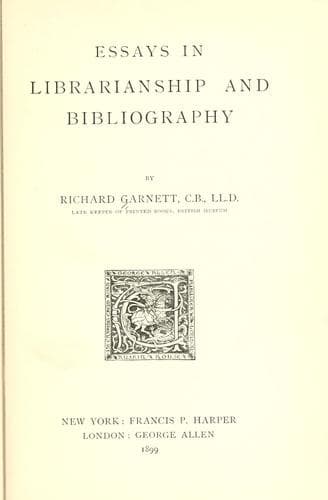
Essays in Librarianship and BibliographyGarnett, Richard
Science
Essays in Librarianship and Bibliography
Garnett, Richard
Bibliography -- Methodology; British Museum; Library science
need rarely brace himself up for a long and expensive journey to one
city or the other. With it, the national treasure is doubly, trebly,
tenfold, or a hundredfold if you like, protected against theft, injury,
or destruction. With it, Ireland might soon possess, at a nominal cost,
facsimiles of all MSS. illustrating her ancient language or history, and
not merely the Ashburnham. But if these propositions are true of the
British Museum, they are true of every national institution. If they
apply to Celtic scholars, they apply to all scholars. If they apply to
the Ashburnham MSS., they apply to all MSS., including parish registers
and public documents; if to these, then to printed books of rarity and
value; and no less to every picture and statue, engraving and medal.
Think of the boundless field thus opened up for the dissemination of
instruction and enjoyment, for the insurance of irreplaceable wealth,
and great must be the wonder that scarcely a corner of it should
hitherto have been occupied.
The cause, nevertheless, is very simple. Photographic reproduction has
not as yet been regarded as a duty incumbent upon a public library, and
has not, accordingly, been provided for out of the public funds. The
same principle has not been applied to it which obtains in the case of
binding, lighting, cleaning, attendance, and other things apart from the
buying of books which are recognised as essential to the efficiency of
such an institution. It follows that photography is so dear as to be
rarely resorted to by private individuals; and that its exercise by
public institutions is impeded not only by considerations of expense,
but also by indispensable but vexatious formalities and restrictions.
Photography, while in private hands, must be costly; first and foremost,
because the photographer must live. Again, if he is an artist of the
accuracy of manipulation required for the work of a public library, he
must be enabled and entitled to put a high value on his services. Again,
he has invested capital both in his education and his working apparatus,
on which he must have interest. Once more, he works by the piece, and
piece labour is always the highest paid. Yet once again, his
remuneration comes to him entirely in money, and not in social position
or distinction. Besides, the demand for the description of photographic
reproduction which a public library would require is as yet but limited,
and partly from these very difficulties of supply. In portraiture, for
which everybody is a customer, and to a less degree in landscape and the
reproduction of works of art, we see that competition has brought the
desired article within reach of the masses. But in photographing books
and MSS. the cost is still very disproportionate to the amount of labour
or the value of material. We move in a vicious circle, the difficulty
of supply restricts demand, and the feebleness of demand obstructs
supply. Nor, were the demand more extensive, would the public be
Public-domain text, read in full here on John Shaqi.
Reviews
Reviews
No reviews yet
Be the first to share your thoughts on this work.
Elsewhere in the archive
Join the Discussion
Join the discussion
Sign in to leave a comment or review.
Sign InorCreate an account