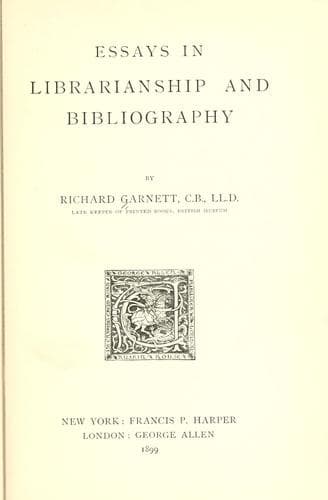
Essays in Librarianship and BibliographyGarnett, Richard
Science
Essays in Librarianship and Bibliography
Garnett, Richard
Bibliography -- Methodology; British Museum; Library science
I shall therefore point out very briefly the great benefit which the
British Museum, the institution with which I am best acquainted, might
derive from incorporating photography as an organised part of its
system, instead of taking the photographer up to lay him down again. I
shall next adduce several instances within my own knowledge in which
cheap photography would have been of material benefit to individual
frequenters of the Museum; sufficient, it seems to me, to justify the
conclusion that a public need exists, to supply which might be
profitable even in a pecuniary sense. Lastly, I shall look beyond the
needs of any individual library, or any particular class of customers,
and endeavour to point out ways in which a national photographic
institution, preferably, I think, placed in connection with the British
Museum, might subserve public objects of paramount importance.
I have said that, to be adopted to any purpose by a public institution,
photography must become a portion of the organism of the institution
itself. That is, the institution must be the photographer's employer,
not his customer. If otherwise, all sorts of needful but troublesome
official formalities must exist, which combine with the obstacle of
expense to reduce photographic enterprise to a minimum. If a complicated
piece of official machinery has to be set in motion every time a
photograph is wanted, whether by a public department or a private
individual, the want is not likely to be often acknowledged, much less
when a moderate outlay will soon bring both to the end of their tether.
Abolish the relations of tradesman and customer, pay the photographer
once for all by an adequate salary, provide apparatus and chemicals with
sufficient liberality, and you at once cut off whatever has hitherto
hindered and arrested the enlistment of the art in the service of
culture. Instead of an artist working now and then as he may happen to
get an order, which he seldom does except in absolutely urgent cases,
you have one bound to devote the whole of his time to earning a moderate
fixed salary, and, if he is the right sort of man, making it his pride
and pleasure to do so. Instead of an institution doing comparatively
little work, and supported by the reluctant contributions of
comparatively few customers, you have one supported on a large scale at
a cost individually imperceptible. Instead of heads of departments
considering how little they can manage to spend, you will have them
encouraged to tax their new auxiliary's resources to the utmost by the
consideration that, the prime elements of expense being eliminated, it
will, in fact, hardly be possible to spend anything. Here I may be met
by an objection which deserves a reply. "Granting," it may be said, "the
propriety of employing the photographer for strictly national purposes,
why tax the entire community, however lightly, for the benefit of the
small portion of it which may happen to want photographs? Is it right to
Public-domain text, read in full here on John Shaqi.
Reviews
Reviews
No reviews yet
Be the first to share your thoughts on this work.
Elsewhere in the archive
Join the Discussion
Join the discussion
Sign in to leave a comment or review.
Sign InorCreate an account