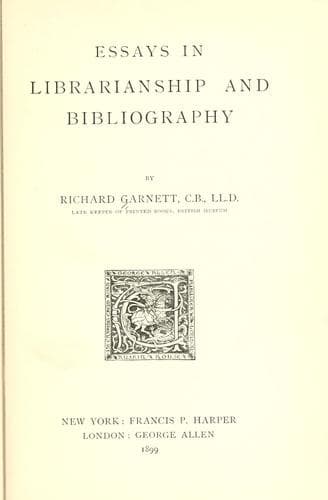
Essays in Librarianship and BibliographyGarnett, Richard
Science
Essays in Librarianship and Bibliography
Garnett, Richard
Bibliography -- Methodology; British Museum; Library science
the general public.
The circulation of photographs of works of art, though important to
individual collectors, is rather the affair of public institutions. The
similar circulation of books and MSS., the aspect of the question with
which we as librarians are particularly concerned, is more directly
interesting to private individuals, and on this account has attracted
comparatively little notice. I am not sure, however, that it is not the
more important of the two, nor that it may not, after all, be the branch
most susceptible of profitable development. In the matter of rare
books, demand has now almost killed supply. The wish to possess them is
more general than ever, but the means of gratifying it become from day
to day more restricted by the tendency of such books to drift into
public libraries, or into large private collections where they may be
locked up indefinitely, and especially by the competition of America. At
this juncture, photography, particularly in its form of
photo-zincography, steps in, and offers the means of doing for the
amateur of ancient and curious literature, for maps and MSS., precisely
what the printing-press does for the great body of readers. All we need
is that the obstacles which still render this process expensive, except
when applied to objects in great demand, should be removed, that the
scholar should be enabled to procure a cheap photographic reproduction
as easily as the general reader can obtain a cheap book. Such scholars
are numerous enough, I feel convinced, to defray the cost of material
and of minor assistance, leaving in the worst case nothing for the State
to pay but the insignificant salary of the chief photographic officer.
Now let us take the case of another class of students, who deserve even
more consideration, the collators of MSS. and rare books. Why should the
scholar of the nineteenth century be in no better position than the
scholar of the sixteenth? Why should he continue to be exposed to
hardships which science has met? Think of the waste of human effort, the
fret and friction of human temper entailed by the inability to procure
accurate facsimiles. Why should the scholar of an age of light get no
good from the sun? Think of the long journeys, the long residences, the
interminable correspondences of scholars, the mechanical labour if they
are their own copyists, the expense and probable inaccuracy if they are
not. Do we often see a critical edition of a classic without a lament
that the editor has been unable to inspect some MS. at Madrid or Moscow?
Did not the Biblical world wait thirty years for a facsimile of the
Vatican MS., which a photographer would have produced in a small
fraction of the time? And did it not prove an imperfect facsimile after
all? Did not the learned Meibomius, albeit a ponderous Dutchman, ill
adapted for equitation, ride all the way from Leyden to Bologna, allured
by the unhappily misleading announcement, _Habemus Petronium integrum_?
Public-domain text, read in full here on John Shaqi.
Reviews
Reviews
No reviews yet
Be the first to share your thoughts on this work.
Elsewhere in the archive
Join the Discussion
Join the discussion
Sign in to leave a comment or review.
Sign InorCreate an account