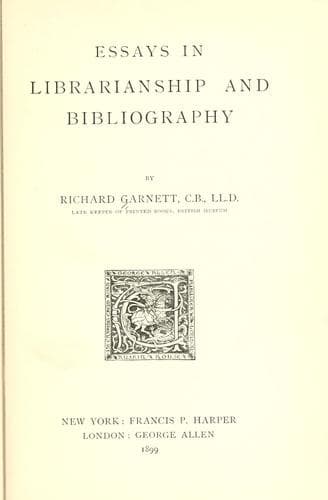
Essays in Librarianship and BibliographyGarnett, Richard
Science
Essays in Librarianship and Bibliography
Garnett, Richard
Bibliography -- Methodology; British Museum; Library science
Of all the library's enemies, the most terrible is fire. Water is bad
enough; is it not recorded that the 450 copies of the Bible Society's
translation of the Gospel of St. Matthew into Manchu, printed on the
soft silken paper of China, were destroyed by an inundation of the Neva?
But such damage can rarely occur, unless when the element of the Sylph
is invoked to combat the element of the Salamander. The muddy waters of
the Neva, also, were probably more pernicious than the "salt sea
streams" would have been. We ourselves have transcribed manuscripts of
Shelley's which had been for months at the bottom of the Mediterranean,
and which, although protected by package, had evidently been soaked with
salt water. Exposure to fire for a hundred-thousandth part of the period
would not have left a letter legible.
The librarian's vigilance and resource, accordingly, ought to be
enlisted against fire in an especial manner, and no contrivance should
be overlooked that seems to afford the least prospect of controlling or
mitigating its ravages.
On July 17, 1884, experiments were made in the garden of Mr. Bernard
Quaritch, the eminent bookseller, with fire-proof cases devised by Mr.
Zaehnsdorf, equally distinguished as a binder, and were reported in the
_Academy_ of July 26. Three books, each enclosed in a separate case,
were put into a fire, and kept there for half-an-hour. On their being
extracted, "one, which had been in a case lined with tin, unpierced with
air-holes, suffered only in its binding, which had been slightly
damaged, not directly by the fire, but only by the heated metal. A
second, of which the case was of the usual kind, but also unpierced with
air-holes, came out intact. The third, in a case resembling that of the
second, but pierced with air-holes of good diameter, suffered most, the
fire, and the water by which the fire was extinguished, having both
found admission through those punctures, the water being the more
deleterious agent of the two. This book was, however, not materially
injured. From this experiment it may be concluded that a good case will
in almost all instances preserve a book from destruction by fire, that a
metal lining to the case is not necessary, and that the air-holes (which
experiments of a different kind have proved to be indispensable) should
be small and numerous, distributed over the top and front edges, and not
only on the top."
In 1894, the chief part of the library of Lord Carysfort at Elton Hall,
Peterborough, was destroyed by fire, these books only escaping which had
been protected by Mr. Zaehnsdorf's cases. On October 3, 1896, Lord
Carysfort wrote: "A few of my books which were in cases were quite
preserved from serious injury, the cases having been blackened and
destroyed, while the book and its binding were scarcely discoloured.
Since the fire I have had all my valuable books put into cases such as
you make."
Public-domain text, read in full here on John Shaqi.
Reviews
Reviews
No reviews yet
Be the first to share your thoughts on this work.
Elsewhere in the archive
Join the Discussion
Join the discussion
Sign in to leave a comment or review.
Sign InorCreate an account