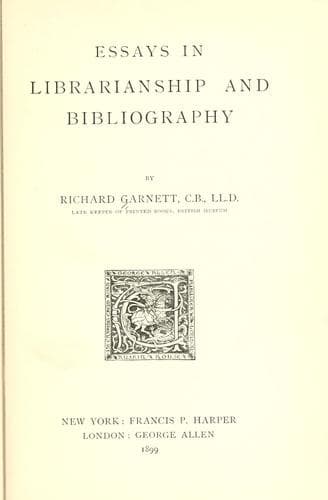
Essays in Librarianship and BibliographyGarnett, Richard
Science
Essays in Librarianship and Bibliography
Garnett, Richard
Bibliography -- Methodology; British Museum; Library science
The principle of a sliding or hanging-press is, so far as I know,
entirely peculiar to the British Museum, and hardly could have
originated elsewhere than in a building possessing, like the Museum,
floors and ceilings entirely grated. The main point, however, the
provision of supplementary presses to increase the capacity of the
library without requiring additional space, had previously been worked
out in at least two libraries. The earliest example, apart from casual
and accidental applications at Trinity College, Dublin, and, as I have
been told, the Bodleian, was, I believe, at Bradford Free Library, and
the gentleman entitled to the credit of its introduction there was Mr.
Virgo, the librarian. Mr. Virgo's contrivance was, I understand, a
double door, not hinged on to the original press in one piece, as in the
pattern I have just described, but opening in two divisions to right and
left, as frequently the case in cupboards. I speak, however, with some
uncertainty, for when, writing on the subject in Mr. Dewey's _Library
Notes_, and most anxious to give Mr. Virgo all due credit, I applied to
him for particulars of his invention, modesty, as I must suppose,
rendered him silent, or at best but insufficiently articulate. I hope he
may be present to-day, and that the Conference may hear the particulars
from himself. It is due, however, to the Bethnal Green Library, the
other institution to which I have referred as having given effect to the
principle of press expansion _in situ_, to state most explicitly that
the idea of its application at the Museum was derived wholly and solely
from Bethnal Green; that the Bradford example, though it had been set
for some years previously, was never heard of at the Museum until the
model had been constructed and the first presses ordered; and that I am
satisfied that Bethnal Green knew as little of Bradford as the Museum
did. The Bethnal Green inventor was, I am informed, the late Dr. Tyler,
the founder and principal benefactor of the institution, and, as
elsewhere, the device was resorted to by him under the pressure of a
temporary emergency—in this case the accumulation of specifications of
patents annually presented by the Patent Office. The introduction of the
principle at the Museum dates from a November evening of 1886, when,
going down to attend a little festivity on occasion of the reopening of
the Bethnal Green Library after renovation, I was shown the
supplementary presses by the librarian, Mr. Hilcken. I immediately saw
the value of the idea, and next morning sent for Mr. Jenner, assistant
in the Printed Book Department, in whose special fitness I felt great
confidence, from his admirable performance of the duty of placing the
books daily added to the Museum, which frequently requires much
ingenuity and contrivance. I told Mr. Jenner what I had seen, and
desired him to consider whether he could devise a method of adapting the
Bethnal Green system to the exigencies of the British Museum. He did
Public-domain text, read in full here on John Shaqi.
Reviews
Reviews
No reviews yet
Be the first to share your thoughts on this work.
Elsewhere in the archive
Join the Discussion
Join the discussion
Sign in to leave a comment or review.
Sign InorCreate an account