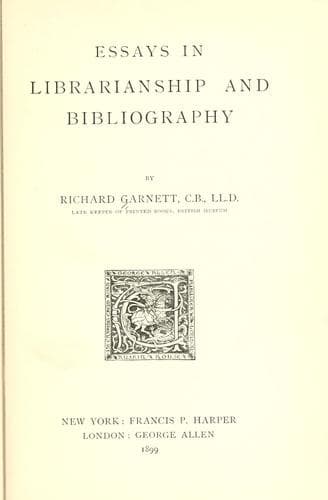
Essays in Librarianship and BibliographyGarnett, Richard
Science
Essays in Librarianship and Bibliography
Garnett, Richard
Bibliography -- Methodology; British Museum; Library science
Whether or no Mr. Blades' treatise might have been more comprehensive
and philosophical, it is undoubtedly very practical, and all its
precepts deserve respectful attention, especially those which have any
reference to heat or ventilation. Book-worms in this favoured country
are now nearly as extinct as wolves (we have seen some imported from
Candia); and against book thieves there is no remedy but lock and key.
The spiritual enemies of literature in this age accomplish their
purpose less by the destruction of good books than by the
multiplication of bad ones, and the present is hardly a suitable
occasion to deal with them. To part, as Mr. Blades would have desired,
so far as may be in charity with all men, we will conclude with the
observation that this much may be said even for the enemies of
books—that they have unintentionally highly encouraged the race of
bibliophilists, whether bookhunters or booksellers. If books had always
received the care and attention which they ought to receive, the
occupation of this interesting class would be as gone as Othello's. The
Gutenberg Bible would exist in two hundred and fifty copies, more or
less. The Caxtons would be numerous, perfect, and in excellent
condition. To find a unique, one would have to resort to such
curiosities as a single impression on vellum, or a special copy prepared
for presentation upon some extraordinary occasion.
FOOTNOTES:
[283:1] Edition of 1896.
SIR ANTHONY PANIZZI, K.C.B.[288:1]
Italy has been fertile in eminent librarians. Magliabecchi was probably
the most learned librarian that ever lived; Audiffredi was the creator
of scientific cataloguing; to Battezzati the practical librarians of the
United States confess themselves indebted for some of their apparently
most original ideas. But it is Sir Anthony Panizzi's especial
distinction to have added to much of the erudition of a Magliabecchi and
all the bibliographical skill of an Audiffredi the more commanding
qualities of a ruler of men. He governed his library as his friend
Cavour governed his country, and in a spirit and with objects nearly
similar, perfecting its internal organisation with one hand, while he
extended its frontiers with the other.
Public-domain text, read in full here on John Shaqi.
Reviews
Reviews
No reviews yet
Be the first to share your thoughts on this work.
Elsewhere in the archive
Join the Discussion
Join the discussion
Sign in to leave a comment or review.
Sign InorCreate an account