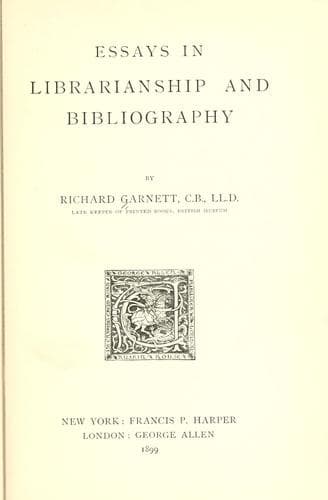
Essays in Librarianship and BibliographyGarnett, Richard
Science
Essays in Librarianship and Bibliography
Garnett, Richard
Bibliography -- Methodology; British Museum; Library science
The distinguished assistance which Panizzi had been able to command for
his edition evinces the hold which he had already acquired upon the best
English society. His urbanity and charm of manner, no less than his
accomplishments, made him irresistible. He was intimate at Holland
House, and on terms of personal friendship with most of the Liberal
statesmen who mainly directed English policy for the next thirty years.
His friends now came into power, and Lord Brougham used his influence
as an _ex officio_ Trustee of the British Museum to secure his
appointment as an extra assistant librarian of the Printed Book
Department (April 27, 1831). When one considers what Panizzi found the
Museum and what he left it, one is in danger of being betrayed into
injustice to the institution and its administrators at that period.
Miserably inadequate as it must appear if tried by our present standard,
there was no conscious deficiency on the part of its official
representatives, and it fully corresponded to the ideal of the public.
The nation, in fact, had scarcely the remotest idea of the organisation
of literary and artistic collections as a branch of the public service.
The records were in a shameful state of dilapidation; the Museum itself
existed only by accident; the National Gallery did not as yet exist at
all. Men like Hallam could honestly confess their perfect content with
the Museum as it was, and, unquestionably, it numbered among its
officers persons of the highest eminence. To mention only Sir Anthony's
immediate official superiors, the Keeper of the Printed Books was a most
accomplished scholar, the Assistant-Keeper had made the standard
translation of Dante. If there was an uneasy spot anywhere it was the
catalogue. The old printed catalogue had become inadequate. Mr. Hartwell
Horne had for some time been engaged on the compilation of a classed
catalogue, which did not seem to promise good results. Mr. Baber, the
Keeper, saw that a good alphabetical catalogue was the indispensable
condition of a classed catalogue, and Panizzi loyally supported him. The
Trustees appeared to be irresolute. While this question was in agitation
the grievances of an assistant, very properly dismissed from the MS.
Department, brought about a Parliamentary inquiry into the general
management of the Museum. In July 1836, Panizzi appeared before the
Committee, and courageously, yet with perfect good taste and official
decorum, laid bare the enormous deficiencies of the national library. A
still more valuable contribution was the mass of evidence supplied by
him with reference to the condition and administration of foreign
libraries, the result of journeys to the Continent undertaken with the
express object of collecting it, and occupying many hundred folio pages
in the Appendix to the Committee's Report. Most valuable of all,
perhaps, was his clear enunciation of the principle that the Museum
ought not to be a mere show-place, as the Government and the country
Public-domain text, read in full here on John Shaqi.
Reviews
Reviews
No reviews yet
Be the first to share your thoughts on this work.
Elsewhere in the archive
Join the Discussion
Join the discussion
Sign in to leave a comment or review.
Sign InorCreate an account