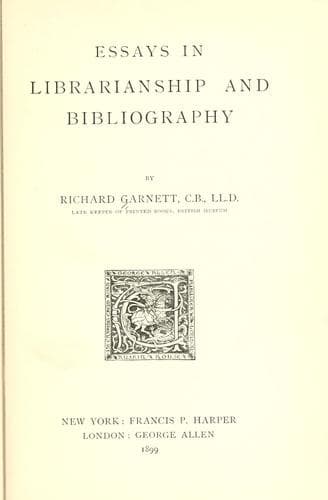
Essays in Librarianship and BibliographyGarnett, Richard
Science
Essays in Librarianship and Bibliography
Garnett, Richard
Bibliography -- Methodology; British Museum; Library science
"Our third and last visit was to a Mr. Hildebrand, a clergyman,
and head-master of the Kibworth free grammar school. This poor
fellow has just had his wife, mother-in-law, eight children,
and two servants confined to their beds with influenza, and
I never beheld an assemblage of more ghastly objects than we
formed at the dinner-table. With the exception of one, we had
all pale cheeks, red eyes, and every other sort of _phizzical_
ugliness, the excepted one had a blue complexion approaching to
black. Mr. Hildebrand, however, assured me the next morning at
breakfast that the hearty dinner he had made, and drinking as
much wine as pleased him (he was, by-the-bye, a long time in
being pleased) had completely removed his disorder. I may make
the same remark respecting myself. The necessity I have been
under of drinking wine every day has almost totally removed my
complaint. I have nothing now to complain of but a considerable
degree of nervous debility, which I hope will depart in a few
days."
The conclusion of the rural peregrinations of the Commission at the
beginning of 1837 threatened Mr. Jones with loss of employment, although
he was still engaged in town in reducing its voluminous proceedings to
print, and the extant correspondence shows that his work was very
important. He says in a letter of this period:—
"I am ready to be knocked down to the highest bidder in any honourable
service, and have no objection to write speeches and pamphlets and frame
bills for laws and schemes for mines provided I am properly remunerated,
but there's the rub." The real occupation of his life, however, was
unexpectedly at hand. Within two months after writing as above he was
appointed (April 1837) to the situation of permanent assistant in the
Printed Book Department of the British Museum. The suggestion that he
should apply for this post seems to have come from his friend Mr.
Nicholas Carlisle, an assistant-officer who had come to the Museum from
Windsor, along with the King's Library, and who is perhaps best
remembered by a work on the endowed grammar schools of England, valuable
in its time. The application was, moreover, strongly supported by Mr.
Johnstone, a member of the Charity Commission, who had been greatly
impressed by Mr. Jones's efficiency in his secretaryship, and who
enlisted his father, Sir Alexander Johnstone's, influence with the
Archbishop of Canterbury, in whose hands all appointments to the Museum
then practically rested. At the end of 1837, upon the resignation of the
Assistant-Keeper, Mr. Cary, Mr. Jones became a candidate for the office.
Short as his connection with the Museum had then been, he still had the
claim of seniority. But he had gained the esteem and confidence of Mr.
Panizzi, the Keeper, and Mr. Panizzi was obnoxious to persons
influential with the Archbishop, who accordingly replied that "his
Public-domain text, read in full here on John Shaqi.
Reviews
Reviews
No reviews yet
Be the first to share your thoughts on this work.
Elsewhere in the archive
Join the Discussion
Join the discussion
Sign in to leave a comment or review.
Sign InorCreate an account