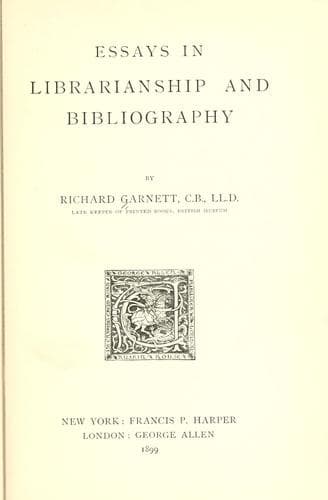
Essays in Librarianship and BibliographyGarnett, Richard
Science
Essays in Librarianship and Bibliography
Garnett, Richard
Bibliography -- Methodology; British Museum; Library science
gratefully—partly by a resolute determination not to aim at an ideal
perfection, which, under the circumstances, would be absolutely
mischievous.
Ordinary visitors to the library may from one point of view be divided
into two classes, those who are astonished that it has not got every
book in the world, and those who marvel that it possesses so many books
as it does. Nothing is commoner than the remark, "I suppose you have
everything that ever was printed," unless it is the exclamation, "You
surely do not keep all the rubbish!" These two sets of ideas may be
taken to represent the two tendencies which affect every public library;
and by consequence every complete catalogue of its contents, that of
mechanical accretion, and that of intelligent selection. The operation
of the Copyright Act is, of course, responsible for most of the element
of "rubbish" in the catalogue; while a moment's thought will show the
impossibility of making the librarian a censor, and allowing him to
exclude whatever might not square with his prejudices or fancies. A
considerable part of the catalogue, therefore, must be devoted to
recording publications of little intrinsic value, but even here there is
an important reservation to be made. Time, which in so many instances
abates the value of what is really precious, makes in a fashion amends
by bestowing worth on what was once of little account. What would we not
give for a _Court Gazette_ of the days of Augustus, or a list of odds at
the Olympic games? There is absolutely no telling what value the most
insignificant details of the nineteenth century may possess for the
nineteenth millennium: even now men of letters might find the same
intellectual stimulus in many a trivial page of the Museum Catalogue, as
a distinguished living orator is said to find in Johnson's Dictionary.
Next to this automatic factor in the increase of the catalogue may be
named the element of seeming accident—the addition to the library of
various classes of books, now at one time, now at another, as apparent
chance, but actual law has prescribed. If we can imagine the various
constituents of the Museum Library piled upon one another in
chronological sequence, and a shaft driven down from the top, we may
conceive ourselves coming upon a succession of strata, as the geologist
finds when he bores for coal, or the archæologist when he explores the
site of a city where men have dwelt from the age of Hercules to the age
of Heraclius. The Museum was founded by a great physician; the library,
therefore, rests upon a sound substratum of old medical books. The King
was the next important benefactor; next above early medicine and natural
history, accordingly, comes a stratum of royal libraries from the first
Tudor to the last Stuart, each a miniature representative of the best
literature of its time. The Hanoverian sovereigns, though no great
patrons of letters, were diligent collectors of pamphlets: hence the
Public-domain text, read in full here on John Shaqi.
Reviews
Reviews
No reviews yet
Be the first to share your thoughts on this work.
Join the Discussion
Join the discussion
Sign in to leave a comment or review.
Sign InorCreate an account