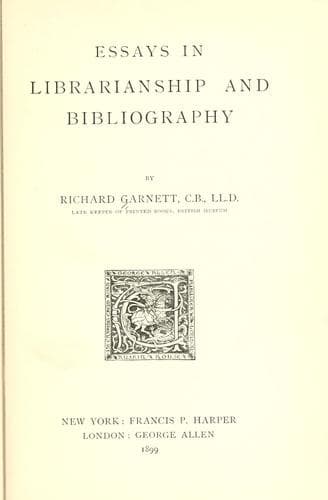
Essays in Librarianship and BibliographyGarnett, Richard
Science
Essays in Librarianship and Bibliography
Garnett, Richard
Bibliography -- Methodology; British Museum; Library science
priceless collection of Civil War and other important tracts which
immediately succeeded the donations already mentioned. As the growth of
the Museum attracted further liberality ("To him that hath shall be
given"), the collection naturally took an impress from the tastes of the
private collectors by whom it was enriched. Hence abundant wealth in
classics and the early literature of the Latin family of languages,
accompanied by poverty in languages which the collectors did not
understand, and subjects for which they did not care. When, thanks to
Panizzi, the library at last obtained an adequate grant for purchases,
the librarian's own intelligence became a much more important factor
than formerly. To continue our metaphor, the contents of the recent
strata would be found far more composite than of old, and more puzzling
to the intellectual geologist. He would come upon various fragmentary
formations, as it were, in which, trifling and remote effects of
prodigious causes, he would discern vestiges of the great events of the
time. Thus the growth of Greater Britain is legible in piles of colonial
newspapers, and the Paris Commune is represented by a mass of
caricatures and the scorched books of an Imperial Prince, literally
saved out of the fire. It is the librarian's business at once to profit
by this tendency to the accumulation of specialities, and to counteract
it: to take advantage of every opportunity that may arise of enriching
the library in definite directions, and at the same time of providing
for the steady influx of miscellaneous literature, alike of the past and
of the present as regards foreign nations: of English contemporary
literature the Copyright Act, as above explained, takes sufficient care.
It seems paradoxical, but it is true, that the Museum should be the home
both of the books which every one expects to find in it, and of those
which no one expects to find—of the literary freight which can ride the
ocean, and of that which would perish without the haven of a public
library. The catalogue must be the mirror of the library, and it is not
the least of the many advantages of print that the public have now much
better means than formerly of judging how the most difficult functions
of librarianship have been understood and discharged at the Museum. In
this connection mention may be made of a minor feature of the
publication of the catalogue of considerable importance: the issue of
extra copies of special articles as excerpts, sold separately at the
lowest possible price. In this manner bibliographies, complete as far as
the Museum collections are concerned, of Aristotle, Bacon, Bunyan,
Byron, Dante, Goethe, and other writers of special importance have been
issued. These should be of great value to students, and would probably
have a large sale if their existence were more generally known. At
present, like other Museum publications, they suffer from imperfect
publicity. Another very valuable appendix to the catalogue of printed
Public-domain text, read in full here on John Shaqi.
Reviews
Reviews
No reviews yet
Be the first to share your thoughts on this work.
Join the Discussion
Join the discussion
Sign in to leave a comment or review.
Sign InorCreate an account