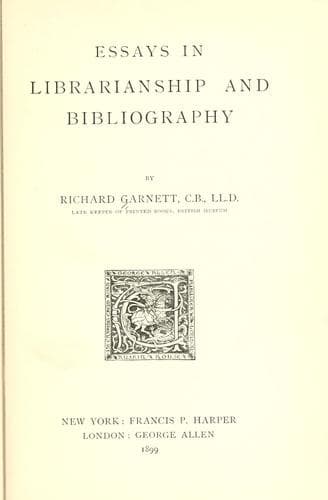
Essays in Librarianship and BibliographyGarnett, Richard
Science
Essays in Librarianship and Bibliography
Garnett, Richard
Bibliography -- Methodology; British Museum; Library science
This slight degustation—analysis it cannot be called—of the fruits of
Italian Renaissance literature confirms the proposition with which we
began, that it was far more utilitarian than that of ages often
stigmatised as matter-of-fact and prosaic. The reproductions of
classical authors were not in general stimulated by enthusiasm for their
beauties, but by their utility, either for the information they
contained, or as books for school or college. Outside their circle very
little of a fanciful or imaginative character appeared, and this chiefly
in the shape of impressions of vernacular authors, such as Dante,
Petrarch, and Boccaccio. Original genius was at almost as low an ebb as
it has ever been, although a band of most gracefully accomplished men of
letters surrounded Lorenzo de' Medici, and Ariosto and Machiavelli were
growing up. In partial explanation of this circumstance, it may be
remarked that the fifteenth century, brilliant in its inventions and
discoveries, was, in a literary point of view, one of the most
unproductive periods in European history. Petrarch and Boccaccio in
Italy, Chaucer in England, left no successors; with the exception of
Æneas Sylvius, it would be difficult to point to any writer of the first
half of the century eminent by his achievements in elegant literature.
Had printing been invented in the thirteenth century, or in the age of
Elizabeth, we might have had a different story to record; but it must
now be said that for a long time it did little for the encouragement of
genius, hardly even of high talent. Yet the age as a whole was by no
means flat or prosaic, only its imagination was more powerfully
attracted to art than to letters, and a spiritual charm is chiefly
recognisable among its books in proportion as art has influenced them,
whether in the design of exquisite type or of beautiful illustration.
This utilitarian character of literature, as we have remarked, tended to
discourage readers for amusement or for the love of letters; and this in
turn discouraged printers and publishers from any serious effort to
provide vernacular reading. Literature accordingly remained for a long
time the property of the humanists, which is as much as to say that it
was imitative and not creative. The merits and defects of this excellent
class of men cannot be better exhibited than by their attitude towards
Greek. It was not one of indifference, they translated Greek authors
into Latin with exemplary pains; but they thought this quite
sufficient, and made no effort to render the originals accessible. They
valued Greek authors for their information, not for their style, and had
no idea of the value of the language as an instrument of education. A
creative epoch was required for this, such as speedily came with the
overthrow of the old order of Italy, with the discovery of America,
above all, with the Reformation. No age can bestow so great a boon upon
literature as the fifteenth century did by the invention of printing;
Public-domain text, read in full here on John Shaqi.
Reviews
Reviews
No reviews yet
Be the first to share your thoughts on this work.
Elsewhere in the archive
Join the Discussion
Join the discussion
Sign in to leave a comment or review.
Sign InorCreate an account