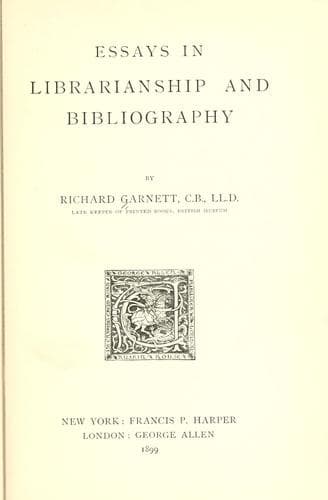
Essays in Librarianship and BibliographyGarnett, Richard
Science
Essays in Librarianship and Bibliography
Garnett, Richard
Bibliography -- Methodology; British Museum; Library science
I scarcely think that I shall underrate the amount of information
respecting Nicius Erythræus current at this time in this country by
remarking that the name is probably best known as a pseudonym of
Coleridge, under which his poem of "Lewti," a Circassian love-chant, was
first given to the world, and most readers will have deemed his adoption
of it a mere freak. I confess that I am myself unable to discover what
Nicius Erythræus has to do with the Circassians, but it is not an
imaginary name, being the Latinisation of that of Vittorio dé Rossi, an
Italian Jesuit, who flourished during the last quarter of the sixteenth,
and the first half of the seventeenth century, and, always writing in
Latin, translated his vernacular appellation into that language. The
circumstance of his having written in Latin is no doubt one principal
reason why he is now so little remembered. He was one of the pioneers of
a reviving form of literature, the anecdotic. Poggio Bracciolini had
written a very popular book of anecdotes in the fifteenth century, but
his tales are often mere Joe Millers, and not always authentic. Nicius's
stories are _bona-fide_ anecdotes or reminiscences of actual personages,
with most of whom he had conversed. All roads, it is said, lead to Rome,
and his position as an ecclesiastic about the Papal court, albeit a
hungry and discontented one (he had sorely prejudiced himself by a
romance, the "Eudemia," in which he had made too free with the
characters of influential people), brought him into contact with every
man of mark who resorted to it, whether a denizen of Rome or a foreign
visitor. His gallery of portraits includes two persons of much interest
to Britain, John Barclay, Scot by descent if French by birth, author of
the "Argenis"; and Teresa, the fair Armenian, who wedded our countryman
Sir Robert Sherley, in his adventurous Persian travels. In my opinion he
is a most entertaining writer, lively and animated, with a bright
descriptive touch; an elegant Latinist, and though much given to
relating stories which the subjects of them would have wished to consign
to oblivion, he is at bottom very good-natured. His principal work is
his "Pinacotheca," or Portrait Gallery, in three parts, each containing
a hundred sketches of contemporaries, all people of some note, if only
for their eccentricities, and many of whom, but for him, would now be
utterly unknown. He doubtless retails much gossip at second-hand, but I
do not think that he has invented anything, and I believe that we see
his contemporaries in his pages much as they really were. For proofs,
authorities, _pièces justificatives_, you must look elsewhere, and
Nicius shuns a date as if it were the number of the beast.
Public-domain text, read in full here on John Shaqi.
Reviews
Reviews
No reviews yet
Be the first to share your thoughts on this work.
Elsewhere in the archive
Join the Discussion
Join the discussion
Sign in to leave a comment or review.
Sign InorCreate an account