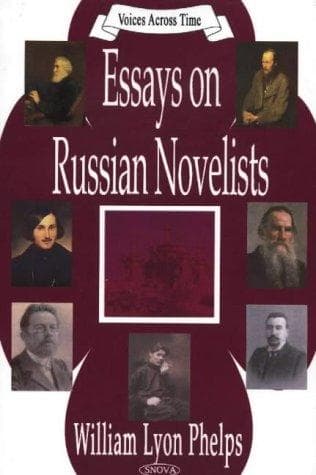
In an admirable article in the "Westminster Gazette," for 14 May 1910,
by the accomplished scholar and critic, Mr. R. C. Long, called "The
Literature of Self-assertion," we obtain a strong smell of the
hell-broth now boiling in Russian literature. "In the Spring of 1909,
an exhibition was held in the Russian ministry of the Interior of
specimen copies of all books and brochures issued in 1908, to the
number of 70,841,000. How many different books were exhibited the
writer does not know, but he lately came upon an essay by the critic
Ismailoff, in which it was said that there were on exhibition a
thousand different sensational novels, classed as 'Nat Pinkerton and
Sherlock Holmes literature,' with such expressive titles as 'The
Hanged,' 'The Chokers,' 'The Corpse Disinterred,' and 'The
Expropriators.' Ismailoff comments on this as sign and portent. Russia
always had her literature of adventure, and Russian novels of manners
and of psychology became known to Westerners merely because they were
the best, and by no means because they were the only books that
appeared. The popular taste was formerly met with naive and outrageous
'lubotchniya'-books. The new craze for 'Nat Pinkerton and Sherlock
Holmes' stories is something quite different. It foreshadows a
complete change in the psychosis of the Russian reader, the decay of
the literature of passivity, and the rise of a new literature of
action and physical revolt. The literature of passivity reached its
height with the (sic) Chekhov. The best representative of the
transition from Chekhov to the new literature of self-assertion is
Maxim Gorki's friend, Leonid Andreev. . . .
"These have got clear away from the humble, ineffectual individual,
'crushed by life.' Full of learned philosophies from Max Stirner and
Nietzsche, they preach, in Stirner's words, 'the absolute independence
of the individual, master of himself, and of all things.' 'The death
of "Everyday-ism,"' the 'resurrection of myth,' 'orgiasm,' 'Mystical
Anarchism,' and 'universalist individualism' are some of the
shibboleths of these new writers, who are mostly very young, very
clever, and profoundly convinced that they are even cleverer than they
are.
"Anarchism, posing as self-assertion, is the note in most recent
Russian literature, as, indeed, it is in Russian life."
Public-domain text, read in full here on John Shaqi.
Reviews
Reviews
No reviews yet
Be the first to share your thoughts on this work.
Elsewhere in the archive
Join the Discussion
Join the discussion
Sign in to leave a comment or review.
Sign InorCreate an account